
Solar Attic Fans: When They Help, When They Cost You Money
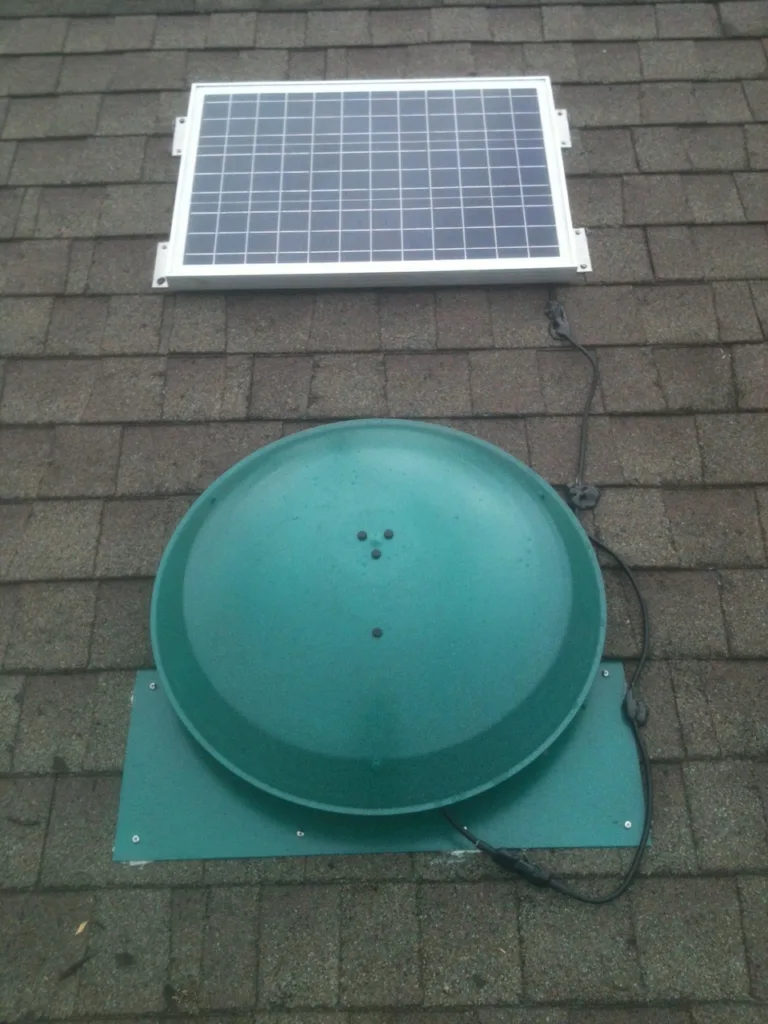
Quick answer: A solar attic fan runs on its own small panel, so it costs nothing to operate and needs no wiring. Whether it helps depends entirely on your attic. If the ceiling below is not air sealed, a powered fan can pull conditioned air out of your house and make your bills worse. Air seal and insulate first. Then, if the attic still runs hot and has enough intake venting, a fan is a cheap and sensible addition.
What this guide covers
- How solar attic fans work
- Do these three things first
- The depressurisation problem
- Ventilation options compared
- Sizing and intake venting
- Moisture and cold climates
- Common mistakes
- FAQ
How solar attic fans work
A solar attic fan is a roof or gable mounted exhaust fan powered by a small photovoltaic panel, usually somewhere between 10 and 40 watts. There is no wiring to the house and no electricity cost.
The fan runs hardest when the sun is strongest, which is also when the attic is hottest. That natural match is the design’s main advantage over a mains-powered fan on a thermostat.
Most units include a thermostat, and better ones include a humidistat too. Some offer an optional battery so the fan keeps running after sunset while the attic is still shedding heat.
The goal is to lower attic air temperature, which reduces heat transfer through the ceiling into living space and lowers the roof deck temperature.
Do these three things first
A fan is the fourth step, not the first. The order matters more than the product choice.
1. Air seal the ceiling plane. Recessed lights, plumbing stacks, wiring penetrations and the attic hatch all leak conditioned air upward. Sealing them is cheap and it is the single highest-value attic job.
2. Insulate to the recommended level. Most older homes are below current recommendations. Adding insulation reduces heat transfer far more reliably than moving attic air does.
3. Confirm passive ventilation is working. Soffit vents blocked by insulation are extremely common. Clearing them, and adding baffles, often solves the heat problem on its own.
Only after those three does a powered fan make sense. Skipping them and installing a fan is treating a symptom.
The depressurisation problem
This is the objection building scientists raise, and it is legitimate.
A fan removes air from the attic. That air has to be replaced. Ideally it comes from soffit and gable vents, meaning outside air.
If intake venting is insufficient, the fan takes the path of least resistance instead. That path is often the leaky ceiling below it. The fan then pulls air-conditioned air out of your living space and into the attic, and outside air is drawn into your home to replace it.
In that scenario the fan increases your cooling load rather than reducing it. It can also, in the worst case, backdraft a naturally vented combustion appliance such as an older water heater. That is a safety issue, not just an efficiency one.
The fix is the same fix as before. Seal the ceiling, and provide generous intake venting. Both are within reach of a competent contractor and neither is expensive.
Ventilation options compared
| Option | Running cost | Depressurisation risk | Notes |
|---|---|---|---|
| Ridge and soffit vents | None | None | The baseline every attic should have |
| Wind turbine vent | None | Low | Depends on wind, bearings wear |
| Solar attic fan | None | Moderate | Needs sealed ceiling and ample intake |
| Mains powered fan | Ongoing | Moderate to high | Higher airflow, higher risk |
| Air sealing plus insulation | None | None | Usually the best return of all |
Sizing and intake venting
A common rule of thumb is roughly 0.7 cubic feet per minute of fan capacity per square foot of attic floor. A 1,500 square foot attic therefore wants somewhere near 1,000 CFM.
Intake area is the number people get wrong. Every code and every manufacturer requires enough net free vent area, and for a powered fan you generally want more intake than exhaust, not less.
The usual baseline is one square foot of net free vent area for every 300 square feet of attic floor when intake and exhaust are balanced. Powered exhaust raises the intake requirement above that baseline.
Net free area is not the same as the hole size. A vent with a screen and louvres may deliver only half its physical opening as net free area. Use the manufacturer’s stated figure.
Also avoid mixing exhaust types. A powered fan combined with a ridge vent can short-circuit, pulling air back down through the ridge instead of from the soffits.
Moisture and cold climates
In cold climates the attic problem is usually moisture, not heat.
Warm humid indoor air leaks into a cold attic and condenses on the underside of the sheathing. That causes mould and rot. Ventilation helps carry that moisture away, which is why a humidistat option is worth having.
But again, the primary fix is sealing the leaks that let humid air up there. A fan running all winter on a cold attic can also increase heat loss if the ceiling is leaky.
Ice dams are a related symptom. They form when heat escaping into the attic melts snow that then refreezes at the cold eaves. See cold climate solar and snow removal for the roof side of that problem.
Common mistakes
Installing a fan on a leaky ceiling. This is the mistake that turns a helpful device into a harmful one.
Blocked soffit vents. Insulation pushed into the eaves cuts off intake. Baffles fix it.
Undersized intake. More exhaust than intake guarantees the fan pulls from inside the house.
Mounting on the wrong slope. The panel needs sun. A fan on a north-facing slope will barely run unless it uses a remote or adjustable panel.
Expecting large bill savings. Measured savings are modest. Treat it as a comfort and roof-longevity measure, with efficiency as a bonus.
FAQ
Do solar attic fans actually save money?
Savings are usually modest and depend heavily on climate and how well the ceiling is sealed. Air sealing and insulation return more per dollar.
Can a solar attic fan make my bills worse?
Yes, if the ceiling below leaks and intake venting is inadequate. In that case the fan pulls conditioned air out of the living space.
What size fan do I need?
A common guideline is about 0.7 CFM per square foot of attic floor, with intake vent area sized above the baseline for powered exhaust.
Do they work on cloudy days?
They run slower. Models with a battery option keep working through cloud and after sunset.
Should I run one in winter?
In cold climates a humidistat-controlled fan can help remove moisture, but sealing air leaks matters more.
Can I combine a fan with a ridge vent?
It is generally discouraged. The fan may draw air back down the ridge instead of pulling it from the soffits.
Do solar attic fans qualify for a tax credit?
Solar-powered products have historically been treated differently from ordinary fans. Confirm current eligibility with a tax professional.
Where to go next
For the wider home efficiency picture, read smart home solar tips and how solar reduces your electricity bill. If your roof work is upcoming, see the installation process.
Attic ventilation and air sealing guidance is published by the U.S. Department of Energy and by ENERGY STAR.
Related Posts


Leave a Comment
Your comment will be published after it has been approved. Please send comments that do not contain slang words.