
How utility solar projects are built
A utility-scale solar project takes years, not months. The panels go up in weeks. Everything before and after that is where the time actually goes.
Understanding the sequence explains a lot that seems strange from the outside. It explains why a project announced in 2024 might energize in 2028. It explains why interconnection, not construction, is usually the critical path.
This guide walks the full development sequence from site selection to commercial operation. It covers who does what, where projects stall, and what happens at the end of the operating life.
Table of Contents
- What Counts as Utility-Scale
- The Development Sequence
- Stage Timeline at a Glance
- Site Selection and Land Control
- Interconnection: The Real Bottleneck
- Offtake: The Contract That Unlocks Financing
- What Actually Happens During Construction
- Who Does What
- Operations and Long-Term Ownership
- Decommissioning and Land Restoration
- Frequently Asked Questions
- Conclusion
What Counts as Utility-Scale
There is no single legal threshold. In practice, utility-scale generally means projects from a few megawatts up to several hundred.
The defining feature is purpose, not size. A utility-scale plant is a standalone generation asset. It sells electricity wholesale into the grid, or under contract to a specific buyer. It does not serve one property’s own consumption.
That distinction drives everything else. A rooftop system answers to a homeowner and a local permitting office. A utility-scale plant answers to a grid operator, a state regulator, lenders, and an offtake counterparty.
The Development Sequence
Projects move through six broad stages. They overlap in practice, but the order rarely changes.
1. Site identification and land control. The developer finds suitable land and secures rights to it, usually through a long-term lease or an option to lease.
2. Interconnection application and studies. The project joins a grid operator’s queue and undergoes a series of engineering studies. This is typically the longest stage.
3. Permitting and environmental review. Local zoning approval, environmental impact assessment, and public comment periods run here, often in parallel with interconnection.
4. Offtake agreement. The developer secures a power purchase agreement, or confirms a merchant market strategy.
5. Financial close. Equity, debt, and tax equity come together. Construction cannot begin in earnest before this.
6. Construction and commissioning. Physical build, testing, and finally permission to operate.
A project can die at any stage. Most that fail do so in interconnection or permitting, long before a single panel is delivered.
Stage Timeline at a Glance
| Stage | Typical duration | Main risk | Who leads |
|---|---|---|---|
| Site control | 3–12 months | Landowner terms, title issues | Developer |
| Interconnection studies | 1–4 years | Queue backlog, upgrade cost | Grid operator |
| Permitting and review | 6–24 months | Local opposition, habitat findings | Developer and authorities |
| Offtake agreement | 6–18 months | Price, counterparty credit | Developer |
| Financial close | 3–9 months | Rates, tax equity availability | Developer and financiers |
| Construction | 6–18 months | Equipment delivery, weather, labor | EPC contractor |
These are typical ranges and they overlap heavily in practice. The pattern to notice is that construction, the visible part, is one of the shorter stages.
Site Selection and Land Control
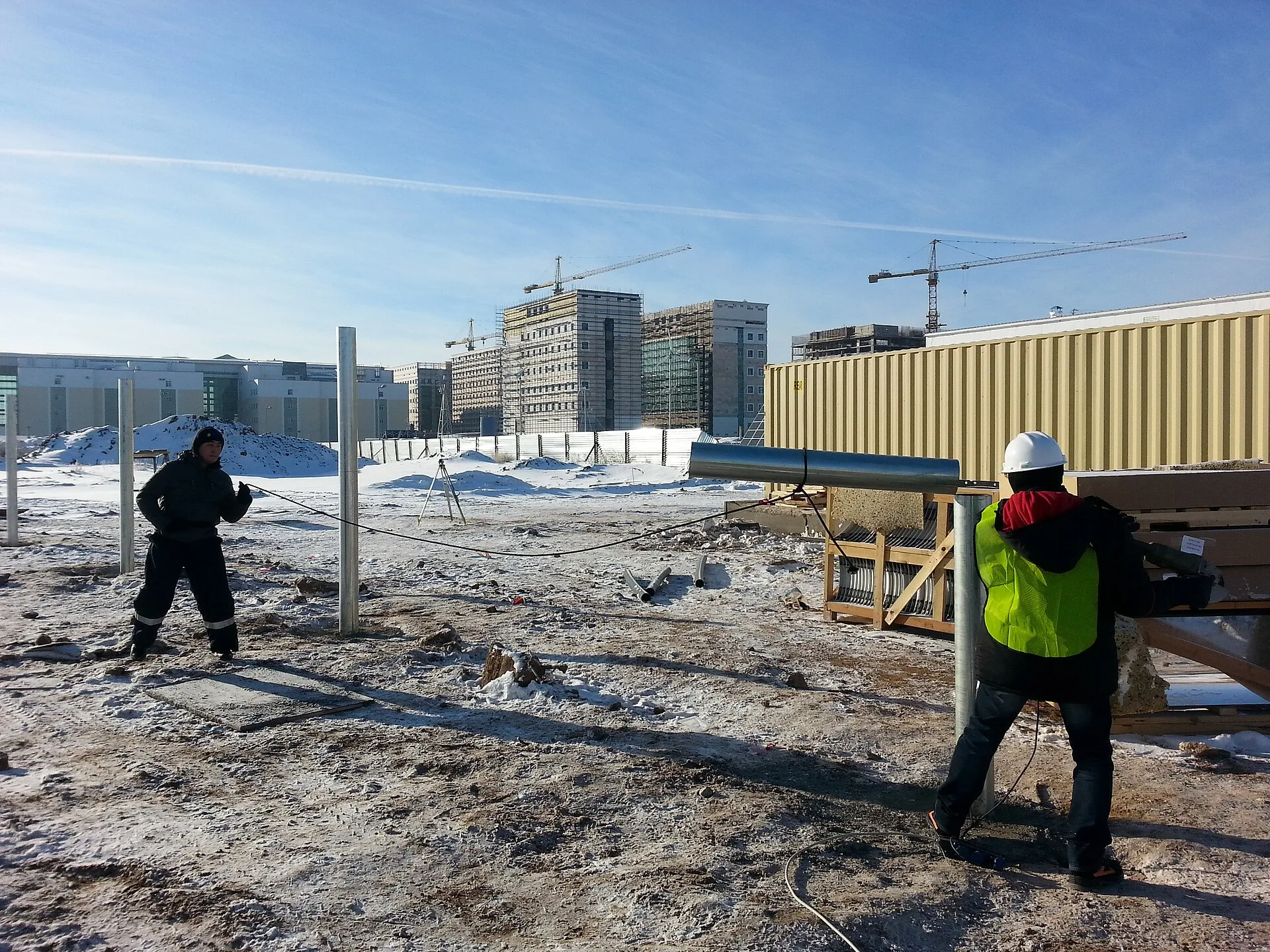
Developers screen land against several criteria at once.
Transmission proximity is often the deciding factor. Land far from adequate grid infrastructure can be unviable no matter how good the solar resource, because new transmission is expensive.
Terrain matters more than people expect. Flat or gently sloped land is significantly cheaper to develop than complex terrain requiring extensive grading.
Solar resource quality sets the production baseline. Environmental sensitivity can rule a site out entirely, since wetlands, protected habitat, and floodplains require extensive mitigation or avoidance.
Local zoning and community acceptance round it out. Some counties have solar-specific ordinances with predictable requirements. Others handle each project through a discretionary conditional-use process.
Land is usually leased rather than bought. Terms commonly run 20 to 30 years or more, with renewal options. Payments are typically a fixed per-acre annual rate, sometimes with escalation. Our land requirements guide covers acreage per megawatt and the land-use tradeoffs.
Interconnection: The Real Bottleneck
If a utility-scale project is late, interconnection is usually why.
The project joins a regional grid operator’s queue and undergoes a sequence of increasingly detailed studies. A feasibility study comes first, then a system impact study, then a facilities study.
Those studies determine how the new generation affects grid stability. They also determine what upgrades the surrounding infrastructure needs, and who pays for them. Upgrade costs can be large enough to kill an otherwise viable project.
Queues in many regions have grown substantially longer in recent years. The cause is simply volume: solar, wind, and storage projects all applying at once. The National Renewable Energy Laboratory publishes ongoing research on interconnection process reform.
This queue-length risk is one of the most significant non-technical challenges facing new projects. It is also largely outside any single developer’s control.
Offtake: The Contract That Unlocks Financing
Lenders do not finance projects on hope. They finance contracted revenue.
A long-term power purchase agreement with a utility or corporate buyer provides exactly that. It fixes a price per megawatt-hour, often with a defined escalation, over 15 to 25 years.
The alternative is merchant sales into the wholesale market at prevailing prices. That carries far more revenue volatility and generally requires a stronger balance sheet or a hedging strategy.
Some projects combine both, contracting a portion and leaving the rest merchant. Whichever route, the offtake position is what determines whether the project can reach financial close. Our solar farm ROI guide covers how these structures affect returns.
What Actually Happens During Construction
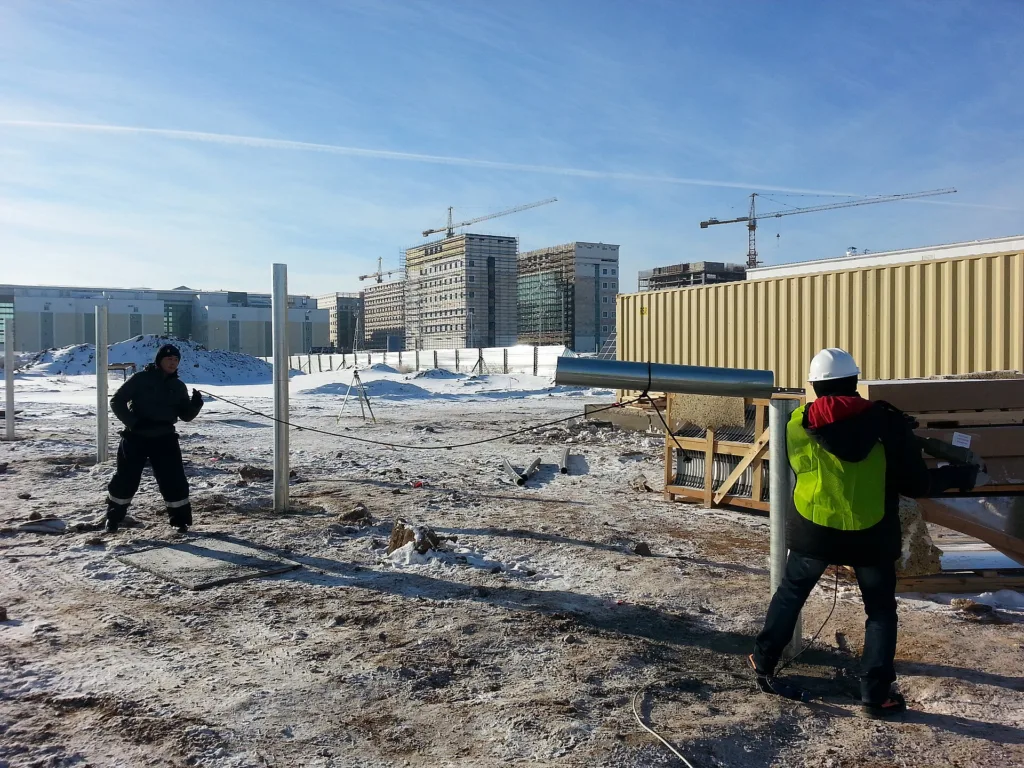
Construction typically runs 6 to 18 months depending on project size.
Civil work comes first. Access roads, grading where needed, and drainage. Then foundations: driven piles or ground screws for fixed-tilt and tracker racking.
Racking assembly follows, then module installation, which is the fastest visible phase. Electrical work runs in parallel: DC collection wiring, combiner boxes, inverters, and medium-voltage collection to the project substation.
The substation and any transmission tie-in are frequently the long pole within construction itself. Utility coordination on the tie-in has its own schedule.
Commissioning closes it out. Testing, protective relay verification, and finally the utility granting permission to operate. Only then does the project earn revenue.
Who Does What
Three distinct roles appear in almost every project. Sometimes one company holds all three. Often they are separate firms.
The developer identifies sites, secures land rights, and shepherds the project through permitting and interconnection. This is the highest-risk, highest-effort stage, and many projects are sold at its conclusion.
The EPC contractor handles engineering, procurement, and construction. They build the project once financing closes, usually under a fixed-price contract with performance guarantees.
The long-term owner-operator runs the asset for its 25-to-35-year life. This may be the original developer, or an infrastructure fund that acquires the operating project.
Understanding this division explains why projects change hands. A sale from developer to owner-operator is normal industry practice, not a warning sign about the project.
Operations and Long-Term Ownership
Once operating, a solar plant is a relatively low-maintenance asset, but not a zero-maintenance one.
Routine work includes module cleaning where soiling is significant, vegetation management, inverter servicing, and tracker maintenance on single-axis systems. Remote monitoring flags underperforming strings.
Inverters are the main mid-life capital item. Central and string inverters at utility scale commonly need replacement or major service well before the modules do. Owners budget for this as a known repowering event rather than a surprise.
Module degradation runs at a low annual percentage, typically well under one percent for current-generation panels. Over 25 years that compounds into a meaningful production decline, which is modeled into the financials from the start. Our degradation guide covers how the numbers work.
Decommissioning and Land Restoration
Modern development agreements increasingly require a decommissioning plan up front.
That plan sets out how equipment will be removed and the land restored at end of life. Many jurisdictions also require financial assurance, such as a bond, ensuring funds exist to carry it out.
This addresses a legitimate community concern. Nobody wants a large solar installation becoming an abandoned liability decades from now.
It also reflects how the industry has matured. Utility-scale solar is now treated as a long-lived infrastructure asset with established end-of-life norms, rather than an emerging technology. The land use is long-term but ultimately reversible.
Storage Co-Location Is Changing the Design
A growing share of new utility-scale solar is built with batteries alongside it from the start.
The reason is economic rather than technical. Solar output peaks at midday, when wholesale prices in high-solar regions are often lowest. Storage lets the project shift some of that output to the evening peak, when power is worth more.
Co-location also shares infrastructure. The project already has land, a substation, an interconnection agreement, and transmission access. Adding storage uses all of it, which is far cheaper than developing a standalone battery site.
This changes the interconnection request too. A solar-plus-storage project may request a lower export capacity than its combined generation, since the battery absorbs the peak rather than exporting it. That can shorten queue time and reduce required upgrades.
Local Economic and Community Effects
Utility-scale projects bring effects distinct from their grid role, and these shape the permitting process heavily.
Construction employment is usually the largest short-term local impact. It is genuinely temporary, typically lasting the 6 to 18 month build.
Land lease payments flow to landowners across the full operating life. For an agricultural landowner, this is a predictable, weather-independent income stream, which is part of the appeal.
Local tax revenue can be significant for smaller rural jurisdictions hosting a large project. The mechanism varies, since some states use standard property tax and others negotiate a payment in lieu of taxes.
Permanent operations jobs are modest. A large plant may need only a small O&M team. Anyone presenting utility-scale solar as a major long-term local employer is overstating it.
Community concerns are also real and worth naming: visual change, agricultural land use, and habitat impact all come up in public comment. Responsible development addresses them through environmental review and siting choices rather than dismissing them. Our environmental impact guide covers the full lifecycle picture.
Three Common Misconceptions
“The project was approved, so it will be built.” Local approval is one of several gates. A project can clear zoning and still fail on interconnection upgrade costs or offtake pricing.
“Panel efficiency drives project economics.” It matters less than land cost, interconnection cost, financing rates, and the offtake price. Module cost has fallen faster than the other components, so it is now a smaller share of total project cost than it once was.
“Delays mean something is wrong with the project.” Most delays reflect regional queue backlog or authority processing times. They are usually outside the developer’s control and say little about project quality.
Frequently Asked Questions
How long does a utility-scale solar project take to build?
Physical construction usually runs 6 to 18 months. Total time from site identification to commercial operation is commonly 3 to 6 years. Interconnection studies and permitting account for most of that.
Why do interconnection queues take so long?
Volume is the main reason. Large numbers of solar, wind, and storage projects apply at once, and each requires sequential engineering studies. The delay usually reflects regional backlog rather than anything specific to one project.
How much land does a utility-scale project need?
Roughly 5 to 10 acres per megawatt is a common planning figure. Actual requirements vary with terrain, tracker versus fixed-tilt racking, row spacing, and setback rules. Usable area is always smaller than parcel area once setbacks apply.
Do landowners sell or lease their land?
Leasing is far more common. Terms typically run 20 to 30 years or longer, with renewal options. Payments are usually a fixed per-acre annual rate, sometimes with escalation clauses built in.
What does a solar farm do to local tax revenue?
It usually increases it, sometimes substantially for smaller rural jurisdictions. The specific mechanism varies by state, since some use standard property tax and others use a negotiated payment in lieu of taxes.
Why do projects change owners before they are built?
Development and long-term ownership are different businesses with different risk profiles and capital needs. Developers specialize in getting projects through permitting and interconnection. Infrastructure investors specialize in owning operating assets. A sale between them is routine.
What happens to the land at the end?
Modern permits generally require a decommissioning plan and financial assurance. Equipment is removed and the land restored under terms agreed before construction. Most agreements treat the use as long-term but reversible.
Conclusion
Utility-scale solar is built on a timeline set by grid access and contracts, not by construction crews.
The visible part, panels going up in a field, is one of the shortest and least uncertain stages. The years before it are spent securing land, working through an interconnection queue, clearing environmental review, and signing an offtake agreement that lenders will accept.
For anyone evaluating a project announcement, that sequence is the useful frame. A project with land control and a completed interconnection study is far closer to reality than one that has only been announced.
Related Posts
Leave a Comment
Your comment will be published after it has been approved. Please send comments that do not contain slang words.