
Bifacial Solar Panels Explained
Bifacial solar panels capture sunlight on both the front and back sides, generating additional power from light reflected off the ground or roof surface beneath them – a genuinely mature, commercially available technology rather than an emerging one, though the real-world production gain depends heavily on installation specifics that many buyers don’t fully understand going in.
This guide explains how bifacial panels actually work. It covers the realistic production gain you can expect, which varies enormously by installation type. It covers where they make the most sense. It also covers how to judge whether the added cost is worth it for your specific project.
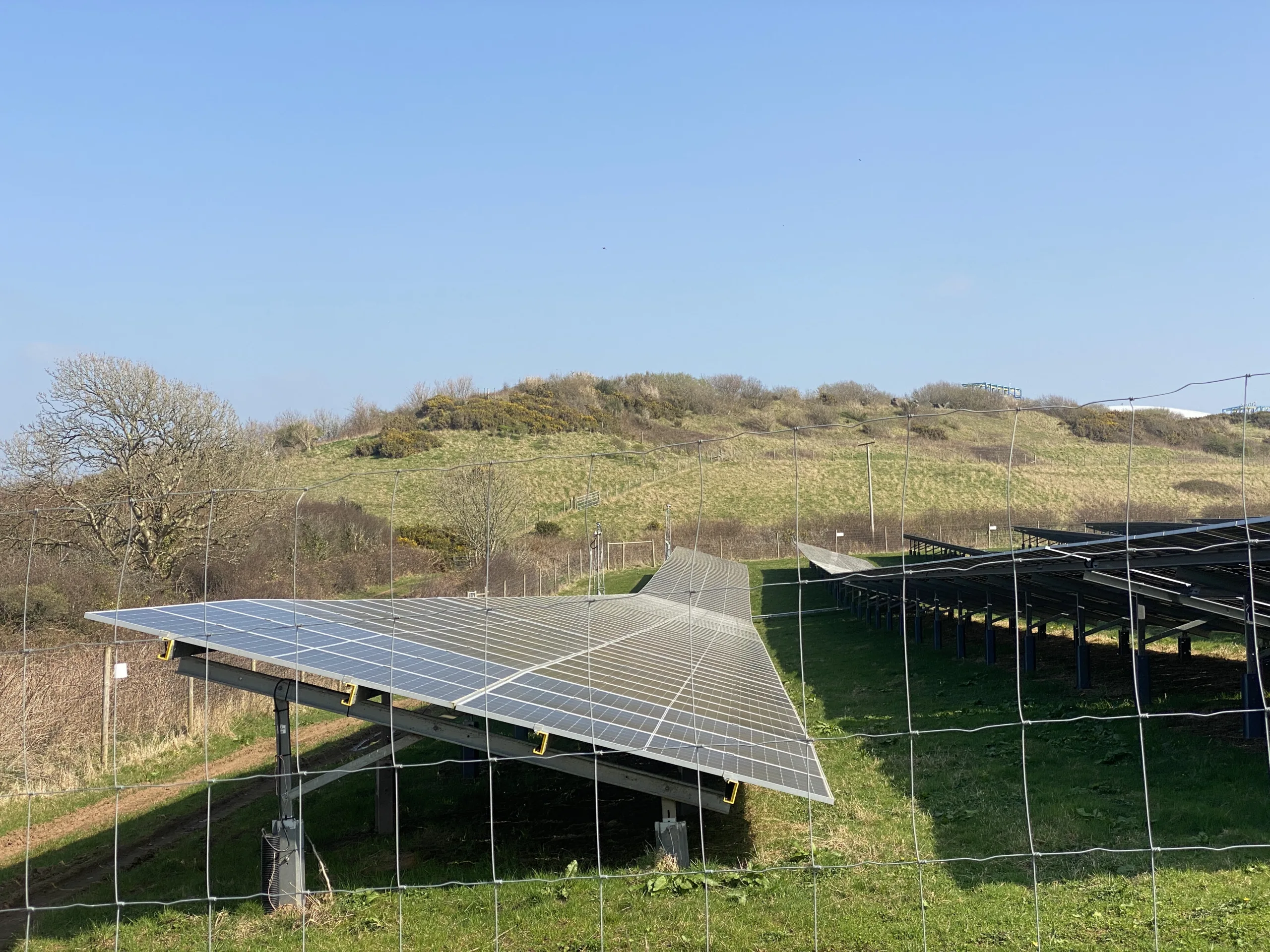
Table of Contents
- How Bifacial Panels Work
- The Realistic Production Gain
- What Affects the Bifacial Gain
- Where Bifacial Panels Make the Most Sense
- The Residential Rooftop Reality Check
- Cost Comparison
- Mounting and Installation Considerations
- A Worked Comparison Example
- Snow and Seasonal Reflectivity Effects
- Bifacial in the Manufacturer Landscape
- Common Mistakes
- Frequently Asked Questions
How Bifacial Panels Work
A bifacial panel uses a transparent or semi-transparent backsheet instead of the standard opaque one. Light passes through gaps in the cell layout, or reflects off the ground or roof beneath the panel. That light reaches the back side of the solar cells and generates additional power. The front side works identically to a standard monofacial panel. The back side adds incremental production on top of that, with the amount depending heavily on how much reflected light actually reaches it.
The Realistic Production Gain
Marketing materials sometimes cite bifacial gain figures up to 30%. Those come from ideal conditions: an elevated ground-mount over a highly reflective surface like white gravel or snow. The figure is technically accurate but not representative of a typical installation. Real-world residential rooftop gains are commonly much more modest, often in the low single digits to around 10%. A rooftop installation simply has far less space and reflectivity beneath the panel than an elevated ground-mount system does. Always ask for a site-specific estimate rather than relying on a generic marketing percentage.
What Affects the Bifacial Gain
| Factor | Effect on Bifacial Gain |
|---|---|
| Mounting height above the surface | Higher elevation allows more reflected light to reach the back side – a key reason ground-mount outperforms rooftop |
| Surface reflectivity (albedo) beneath the panel | White gravel, snow, or light-colored surfaces reflect much more light than dark roofing or soil |
| Panel tilt angle | Steeper tilt generally exposes more of the back side to reflected light |
| Row spacing (for arrays) | Wider spacing reduces shading between rows, improving both front and back-side performance |
Where Bifacial Panels Make the Most Sense
Bifacial technology shows its strongest advantage in utility-scale and commercial ground-mount installations with elevated racking over reflective ground cover (white gravel or similar surfaces are sometimes specifically chosen to maximize bifacial gain) – see our utility-scale solar guide for that context. Carports and elevated structures with open space beneath also perform well, since the mounting height and open reflective area beneath naturally suit the technology.
The Residential Rooftop Reality Check
A typical residential rooftop installation mounts panels flush or close to a dark asphalt shingle roof. That captures relatively little of bifacial technology’s theoretical advantage. There is minimal space and low reflectivity beneath the panel. Some homeowners still choose bifacial panels for a rooftop installation. They get a modest gain plus other product-line advantages, since some manufacturers’ bifacial lines carry stronger warranties or better front-side specs. The up-to-30% marketing framing should not be the expectation for a standard rooftop install.
Cost Comparison
Bifacial panels typically carry a modest price premium over comparable monofacial panels. It often runs from a few percent to around 10% more per panel. That gap has narrowed as bifacial manufacturing has scaled. Whether that premium pays for itself depends entirely on your specific installation’s realistic bifacial gain – run the numbers for your actual mounting situation (elevated ground-mount vs. standard rooftop) rather than assuming the premium is automatically worthwhile.
Mounting and Installation Considerations
Getting meaningful bifacial gain requires mounting hardware and racking design suited to the technology. Open-frame racking that does not block the back side is one requirement. Adequate elevation above the ground or roof surface is another. For ground-mount installations, a lighter-colored ground treatment chosen specifically to boost reflectivity helps too. A bifacial panel bolted flush to a standard rooftop racking system, the same way a monofacial panel would be, captures only a fraction of the technology’s potential advantage.
A Worked Comparison Example
| Scenario | Typical Bifacial Gain | Notes |
|---|---|---|
| Standard flush rooftop, dark shingles | 1-4% | Minimal reflective surface and clearance beneath the panel |
| Rooftop with light-colored membrane/coating, some clearance | 4-8% | Better than dark shingles but still limited by rooftop constraints |
| Elevated ground-mount, standard soil/grass | 8-15% | Meaningful elevation helps even without a specially reflective surface |
| Elevated ground-mount, white gravel or snow-covered ground | 15-30%+ | Near-ideal conditions, closest to marketing headline figures |
These ranges are illustrative rather than precise for any specific site. Actual gain depends on the exact combination of height, tilt, row spacing, and surface reflectivity. That is why a site-specific modeling estimate from your installer is more reliable than any generic table, including this one.
Snow and Seasonal Reflectivity Effects
Bifacial panels in snowy climates can see a temporary production boost. Snow-covered ground reflects light onto the back side during winter months. This happens even as front-side production drops from reduced daylight hours and any snow accumulating on the panels themselves. This seasonal effect is a genuine if secondary consideration for buyers in snowy regions. It should not be the primary factor driving a bifacial-versus-monofacial decision on its own. The effect varies too much by latitude, typical snow cover duration, and panel tilt angle.
Bifacial in the Broader Manufacturer Landscape
Bifacial capability has become common across major manufacturers’ product lines rather than a specialty niche. Newer cell technologies help. TOPCon and similar designs are often naturally bifacial-capable as part of their base design, rather than requiring a separate manufacturing process. This means the “monofacial vs. bifacial” choice increasingly overlaps with the broader cell-technology comparison covered in our solar panel brands guide – ask your installer whether a specific quoted panel’s bifacial capability is a genuine differentiator worth a price premium, or simply an inherent feature of the underlying cell technology being quoted either way.
Common Mistakes
- Expecting rooftop-level gains matching ground-mount marketing figures – the “up to 30%” numbers reflect ideal elevated, reflective-surface conditions, not typical rooftop installs.
- Paying the bifacial premium without a site-specific gain estimate – ask your installer to model your actual mounting situation, not a generic percentage.
- Using standard flush-mount racking and expecting full bifacial benefit – the mounting approach itself needs to suit the technology.
- Assuming bifacial panels are inherently “better” regardless of installation type – the advantage is real but installation-dependent, not universal.
Frequently Asked Questions
How much extra power do bifacial panels actually produce on a home rooftop?
Often modest – low single digits up to around 10% in typical residential rooftop conditions, well below the “up to 30%” figures that reflect ideal elevated ground-mount installations over reflective surfaces.
Are bifacial panels worth the extra cost for a residential rooftop?
Depends on your specific roof and mounting – ask for a site-specific gain estimate before assuming the modest price premium pays for itself. The case is generally stronger for ground-mount installations than typical rooftop ones.
Do bifacial panels need special racking?
To capture meaningful benefit, yes – open-frame racking that doesn’t block the back side and adequate elevation above the surface beneath matter. A standard flush-mount rooftop install captures only a fraction of the technology’s potential.
Can bifacial panels be used on any roof?
Technically yes, they function like standard panels on the front side regardless of mounting, but the back-side production advantage is limited on a typical flush-mounted rooftop compared to elevated ground-mount installations.
Do bifacial panels have different warranties than standard panels?
Sometimes better, depending on the manufacturer’s specific product line – check the specific written warranty terms rather than assuming, since this varies by brand and isn’t a universal bifacial-technology characteristic.
Do bifacial panels perform better in snowy climates?
They can see a seasonal back-side boost from snow-covered ground reflecting light, though this is a secondary effect – not something to base a purchase decision on alone, and front-side production still drops with reduced winter daylight and any direct snow accumulation on the panels.
What’s a realistic bifacial gain for an elevated ground-mount system on standard grass or soil?
Commonly in the 8-15% range – meaningful but well below the 15-30%+ figures associated with specially reflective surfaces like white gravel or snow cover.
Conclusion
Bifacial solar panels are a mature, real technology with a genuine production advantage. That advantage depends heavily on mounting height, ground reflectivity, and installation type. Typical residential rooftop gains therefore fall well short of ideal-condition marketing figures. Get a site-specific estimate before paying the premium. See our best solar panel brands guide for the broader panel-selection comparison this fits into.
Further reading: NREL – Bifacial Solar Photovoltaics Research and Wikipedia – Bifacial solar cells.
We take this further in our MC4 connectors explained. This is covered separately in our floating solar panels guide.
Related Posts
Leave a Comment
Your comment will be published after it has been approved. Please send comments that do not contain slang words.