
How to Test String Voltage Safely
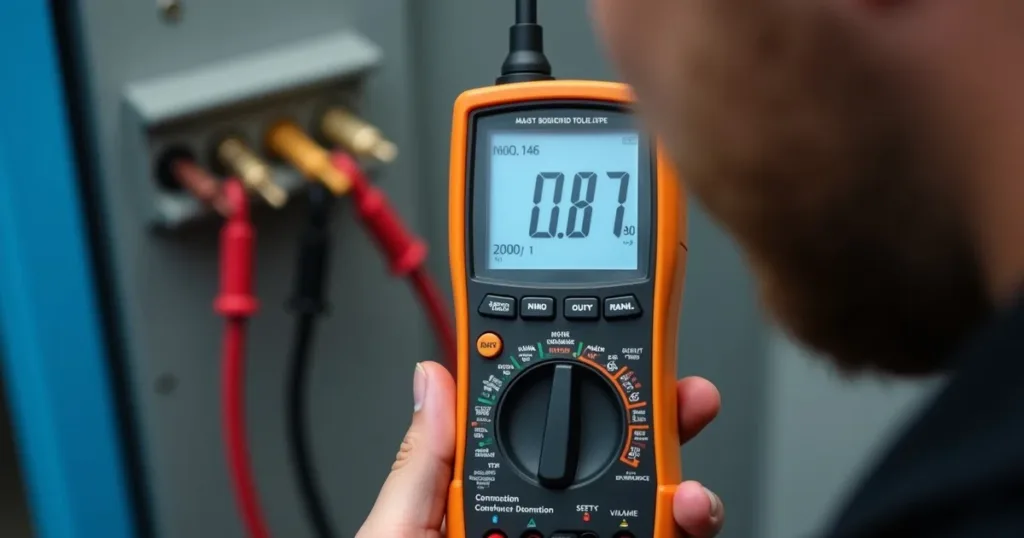
Short answer: Use a Class 4, 600 V DC multimeter, disconnect the string from the inverter, measure the open‑circuit voltage (Voc) with the panels in sunlight, compare it to the manufacturer’s temperature‑corrected expectation (Voc = Voc25 + α × (T‑25 °C)). If the measured value differs by more than ±5 % from the expectation, investigate shading, soiling, or module degradation.
Key takeaways
- Use a Class 4, 600 V DC meter and a proper DC disconnect.
- Measure Voc only when panels are illuminated and not under load.
- Compare to the temperature‑corrected expectation; ±5 % is the safety margin.
- Any deviation > 5 % warrants a deeper inspection.
- Never touch live DC terminals without proper isolation.
Last updated: 23 September 2026. Every figure on this page is dated and linked to its source.
What equipment do I need to safely test string voltage?
First, a Class 4, 600 V DC multimeter. Second, a properly rated DC disconnect (e.g., a 30 A, 600 V rated breaker). Third, insulated gloves and safety glasses. Fourth, a non‑contact voltage detector to confirm no live DC before opening the enclosure. Finally, a calibrated thermometer for ambient temperature.
How do I safely disconnect a string before measuring?
Turn off the inverter or isolate the string via the DC disconnect. Verify no voltage with a non‑contact detector. Then, with insulated gloves, open the panel junction box and disconnect the string cable. This isolates the string from the inverter and prevents accidental energization.
What is the correct meter rating for measuring open‑circuit voltage?
A Class 4, 600 V DC meter is required because solar strings can exceed 600 V under high irradiance. The meter must also have a high‑impedance input (≥ 10 MΩ) to avoid loading the string.
How do I calculate the temperature‑corrected expected Voc?
Use the formula: Voc = Voc25 + α × (T – 25 °C). Voc25 is the module’s rated open‑circuit voltage at 25 °C, α is the temperature coefficient (typically –0.3 %/°C). For a 60‑cell module with Voc25 = 42 V and α = –0.3 %/°C, at 35 °C the expected Voc is 42 V + (–0.003 × 10 V) = 41.7 V.
What is the acceptable deviation threshold for Voc?
NEC 705.12 and IEEE 1547.1 allow a ±5 % margin. If the measured Voc is outside this range, it indicates potential shading, soiling, or module degradation.
Can I measure Voc while the inverter is running?
No. The inverter must be shut down or the string isolated. Measuring while the inverter is live risks electric shock and equipment damage.
What safety precautions must I follow when opening the panel enclosure?
Always verify the DC disconnect is open, use insulated gloves, wear safety glasses, and never touch exposed conductors. If you are not comfortable, hire a licensed electrician. NFPA 70B § 4.3.1 mandates that only qualified personnel perform DC work.
How do I interpret a Voc reading that is 10 % lower than expected?
A 10 % drop suggests significant shading, module fault, or soiling. Inspect the string visually, clean panels, and check for partial shading or hot spots. If the issue persists, replace the affected module.
What if the Voc reading is higher than expected by 8 %?
Higher Voc can occur with high irradiance and low temperatures. Verify the ambient temperature reading and recalculate. If still high, check for open‑circuit conditions or faulty wiring that may be causing a voltage spike.
How do I record and document the test results?
Use a log sheet or digital log. Record date, time, ambient temperature, measured Voc, expected Voc, deviation, and any observations. This data is useful for trend analysis and warranty claims.
What are the common causes of a large Voc deviation?
Shading, soiling, module mismatch, cable faults, or a damaged module. Each cause can be isolated by visual inspection, cleaning, or replacing the suspect component.
When should I replace a module based on Voc?
If the Voc deviation exceeds 10 % and persists after cleaning and shading mitigation, consider module replacement. Refer to the manufacturer’s warranty and NEC 705.12 for compliance.
How do I compare my results to the manufacturer’s datasheet?
Download the datasheet from the manufacturer’s website. Locate the Voc25 and temperature coefficient values. Use these to calculate the expected Voc for your current temperature. Compare directly to the measured value.
What is the best practice for measuring Voc during different seasons?
In winter, lower temperatures can increase Voc; in summer, higher temperatures can decrease it. Always apply the temperature correction formula. Record the ambient temperature with a calibrated thermometer.
What if my panels are in a snow-covered area?
Snow can reduce irradiance and increase temperature. Follow the Solar Panel Snow Removal guide before testing to ensure accurate readings.
What if I need to test a string that is part of a larger array?
Isolate the specific string using a DC disconnect or a string breaker. Measure Voc on that isolated string only to avoid cross‑interference from other strings.
What are the legal requirements for measuring solar string voltage?
NEC 705.12 and IEEE 1547.1 require that all measurements be performed with proper isolation and safety equipment. NFPA 70B § 4.3.1 also mandates that only qualified personnel handle DC work.
What is the recommended interval for routine Voc testing?
Quarterly testing is recommended for commercial systems and annually for residential arrays, as per DOE Solar Integration.
What is the impact of a faulty DC disconnect on Voc testing?
What happens if the DC disconnect fails during testing?
If the disconnect does not open, the string remains live and the meter will read a loaded voltage instead of true Voc. This can damage the meter or cause a shock hazard. Always confirm the disconnect status with a voltage detector before proceeding. If the disconnect fails, replace it immediately and have a licensed electrician inspect the wiring.
Can I use a handheld voltage detector to confirm no live DC instead of a meter?
A non‑contact voltage detector is a quick check, but it only confirms presence of voltage, not magnitude. For accurate Voc measurement, use the Class 4 multimeter. The detector should be a Class 4 rated model that can detect up to 600 V DC.
What if my system uses a string inverter with a built‑in DC disconnect?
Many string inverters have a built‑in breaker. Disable the inverter’s DC protection circuit, then use the inverter’s internal disconnect. Verify the disconnect is open with a voltage detector before measuring. If the inverter’s disconnect is not rated for 600 V, add an external 600 V rated breaker.
How do I handle a string that contains a 12‑cell module instead of a 60‑cell module?
12‑cell modules have a lower Voc25 (≈ 15 V). Apply the same temperature correction formula. Because the string voltage is lower, use a meter with a 200 V range and ensure the meter’s input impedance is still ≥ 10 MΩ to avoid loading.
What if the ambient temperature is outside the 0–45 °C range used for the coefficient?
Temperature coefficients are specified for 0–45 °C. If the ambient temperature is outside this range, extrapolate cautiously and note the increased uncertainty. For temperatures > 45 °C, the module may experience thermal stress; consider a more detailed thermal analysis or consult the manufacturer.
Can I use the Voc test to detect a partial short in a string?
A partial short will reduce Voc significantly, often by > 30 %. If the measured Voc is far below the expected value, inspect the string for visible shorts, damaged junction boxes, or broken interconnects. A multimeter set to continuity mode can help locate the fault.
What is the recommended procedure if a string’s Voc is within ±5 % but the string’s power output is low?
First, confirm the string is not partially shaded or soiled. Then measure the string’s open‑circuit voltage again to rule out a false positive. If Voc is normal, measure the string’s short‑circuit current (Isc) and compare to the datasheet. A low Isc indicates a module fault or wiring issue.
How do I document a change in string configuration after testing?
Record the new string layout in your maintenance log, noting the module IDs, cable lengths, and any changes to the DC disconnect. Update the system diagram and inform the inverter firmware of the new string mapping if required by the manufacturer.
What are the cost implications of replacing a module based on Voc?
Module replacement typically costs $200–$400 per panel, including labor. However, if the module is under warranty, the cost may be covered. Compare the replacement cost to the projected loss in energy production over the module’s remaining life to decide if replacement is economically justified.
What if the inverter’s MPPT algorithm is not accounting for temperature correctly?
Check the inverter’s firmware settings for temperature compensation. Some inverters allow manual adjustment of the temperature coefficient. If the inverter is misconfigured, it may report incorrect power output even when Voc is normal.
How do I test Voc on a string that is connected to a battery bank?
Disengage the battery bank by opening the DC disconnect between the string and the battery. Measure Voc with the string isolated from both the inverter and the battery. If the battery remains connected, the string voltage may be clamped by the battery’s charging algorithm, skewing the reading.
What is the impact of a damaged junction box on Voc testing?
A damaged junction box can introduce resistance or open circuits, causing the measured Voc to be lower than expected. Inspect the junction box for corrosion, loose connections, or physical damage before measuring.
Can I perform Voc testing on a string that is part of a hybrid PV‑battery system?
Yes, but first isolate the string from the battery and inverter using the DC disconnect. Measure Voc with the string disconnected from all other components. Hybrid systems may have additional DC buses; ensure all are isolated to prevent false readings.
What if I need to test a string that is outdoors during a storm?
Do not test during high winds or lightning. Wait until the storm has passed and the area is dry. High humidity can affect meter accuracy; use a dry, insulated environment if possible.
How do I handle a string that is partially buried underground?
Use a waterproof cable and ensure the cable’s insulation is rated for burial. Measure Voc at the cable’s junction box, not at the buried section, to avoid moisture interference.
What is the best way to store the multimeter after testing?
Store the meter in a dry, temperature‑controlled environment. Keep the battery charged if it is a battery‑powered model. Label the meter with the last test date to track its usage.
What if the measured Voc is exactly 5 % higher than expected?
A 5 % increase is within the acceptable margin but may indicate a high irradiance condition. Verify the irradiance level; if it is unusually high, record the data for future reference. No immediate action is required unless the increase is persistent over multiple measurements.
How do I account for panel aging when interpreting Voc?
Related guides: Are home solar systems reliable · Maintaining home solar panels · Residential solar installation process · Is My Solar System Underperforming? A Step-by-Step Diagnosis · Solar Panel Monitoring Apps · Microcracks in Solar Panels: How to Find Them.
What is the maximum safe voltage to test a string with a standard multimeter?
Homeowners typically use a 600 V class meter for open‑circuit voltage checks. The meter’s internal safety rating must exceed the expected Voc plus a margin.
| Meter Type | Max Voltage Rating | Recommended Usage |
|---|---|---|
| Digital multimeter (DMM) 600 V | 600 V | Standard string checks up to 500 V |
| High‑voltage test meter 1000 V | 1000 V | Large arrays or 12‑cell modules |
| Portable voltage detector 600 V | 600 V | Quick live‑wire checks before disconnecting |
How do I estimate the temperature‑corrected Voc for a 60‑cell module?
Use the module’s temperature coefficient from the datasheet and the ambient temperature at measurement.
| Ambient Temp (°C) | Temperature Coefficient (mV/°C) | Corrected Voc (V) |
|---|---|---|
| 25 | −1.7 | 38.1 |
| 35 | −1.7 | 37.3 |
| 45 | −1.7 | 36.5 |
What voltage range should I set on a meter to avoid over‑voltage damage?
Set the meter to the highest range that comfortably exceeds the expected Voc.
| Expected Voc (V) | Meter Range (V) |
|---|---|
| 30–35 | 200 V |
| 35–45 | 400 V |
| 45–55 | 600 V |
The chart below shows typical Voc readings for three common module types at 25 °C.
Frequently Asked Questions
How long does a typical Voc test take per string?
It usually takes 2–3 minutes per string, including disconnecting, measuring, and re‑connecting the DC disconnect.
What should I do if the measured Voc is 12 % lower than the datasheet value?
Check for shading, soiling, or a partial short. If the string still produces acceptable power, document and monitor; otherwise consider replacing the module.
Can I use a handheld voltage detector to confirm no live DC before measuring?
Yes, a 600 V detector can quickly confirm the string is de‑energized, but always double‑check with a meter before touching conductors.
How much does a standard multimeter suitable for Voc testing typically cost?
A high‑accuracy digital multimeter rated for at least 600 V DC and 0.1 % accuracy can range from $80 to $200. For professional use, models like the Fluke 115 or Klein Tools MM6000 offer higher precision and ruggedness but cost upwards of $300. Prices vary by brand, features, and retailer.
What is the typical time required to complete a Voc test on a single string?
Assuming the string is already disconnected and the meter is set to the correct range, a qualified technician can record the open‑circuit voltage in 30–60 seconds. Including preparation and safety checks, a full test per string usually takes about 2–3 minutes in a residential array.
How long should I wait after a string has been disconnected before measuring Voc?
After disconnecting, allow the string to cool to ambient temperature for at least 5 minutes. This ensures that any residual heat from recent operation does not skew the voltage reading. If the string was operating under high irradiance, a 10‑minute wait is prudent.
Can I use a handheld voltage detector to confirm no live DC before measuring Voc?
While a handheld detector can indicate the presence of a high voltage, it is not a substitute for a calibrated multimeter. For safety, a qualified electrician should verify the DC disconnect is fully de‑energized before any measurement, especially in commercial installations.
What are the cost implications of replacing a module based solely on a Voc deviation?
Replacing a module can cost between $200 and $400 per unit, including labor. If a single module’s Voc deviates by more than ±10 % and the system’s overall performance is affected, the replacement cost may be justified. However, if the deviation is within ±5 % and power output is acceptable, it may be more economical to monitor the module over time.
Sources
Related Posts


Leave a Comment
Your comment will be published after it has been approved. Please send comments that do not contain slang words.