
Van Life Solar: Sizing a System That Actually Works
Quick answer: Build the system in this order: energy budget, then battery, then charging sources. Roof space limits most vans to somewhere between 200 and 600 watts, which is enough for a fridge, lights, laptops and water pump, and nowhere near enough for air conditioning or induction cooking. The component most first builds skip is a DC to DC charger from the engine, and it is often more valuable than another panel.
What this guide covers
- Start with an energy budget
- Choosing the battery
- Typical loads
- Panels and roof reality
- Three charging sources, not one
- Common mistakes
- FAQ
Start with an energy budget
Everything downstream depends on this number, and guessing it is why so many builds disappoint.
List every load. For each one write down its watts and the hours per day it runs. Multiply to get watt-hours. Add them up.
Be honest about the fridge. It is almost always the largest single consumer in a van because it runs all day and all night, and its duty cycle rises sharply in hot weather. A compressor fridge that uses 300 watt-hours a day in spring can use 700 in a desert summer.
Add roughly 20% headroom for inefficiency in wiring, charging and inversion. That total is your daily requirement.
Choosing the battery
Lithium iron phosphate has become the default for good reasons, and the comparison is not close for most builds.
You can use roughly 80% to 90% of a lithium bank’s rated capacity. With lead acid you should only use about 50% if you want it to last. So a 100 amp-hour lithium battery delivers roughly the same usable energy as a 200 amp-hour lead acid bank, at a fraction of the weight.
Weight matters in a van more than almost anywhere else. Payload is limited and lead acid is heavy.
The one genuine caution is cold. Lithium iron phosphate must not be charged below freezing without internal heating. If you plan winter trips, buy a battery with a built-in heater or a battery management system that blocks cold charging.
See off-grid solar batteries for the wider chemistry comparison.
Typical loads
| Load | Rough daily energy | Notes |
|---|---|---|
| 12V compressor fridge | 300 to 800 Wh | Doubles in hot weather |
| LED lighting | 20 to 60 Wh | Negligible |
| Laptop and phones | 100 to 300 Wh | Use DC chargers where possible |
| Water pump | 20 to 50 Wh | Short bursts |
| Diesel heater | 100 to 400 Wh | Glow plug draws heavily at startup |
| Induction hob | 300 Wh per 15 minutes | Needs a large inverter and bank |
| Air conditioning | 2,000 Wh and up | Beyond most van solar systems |
Panels and roof reality
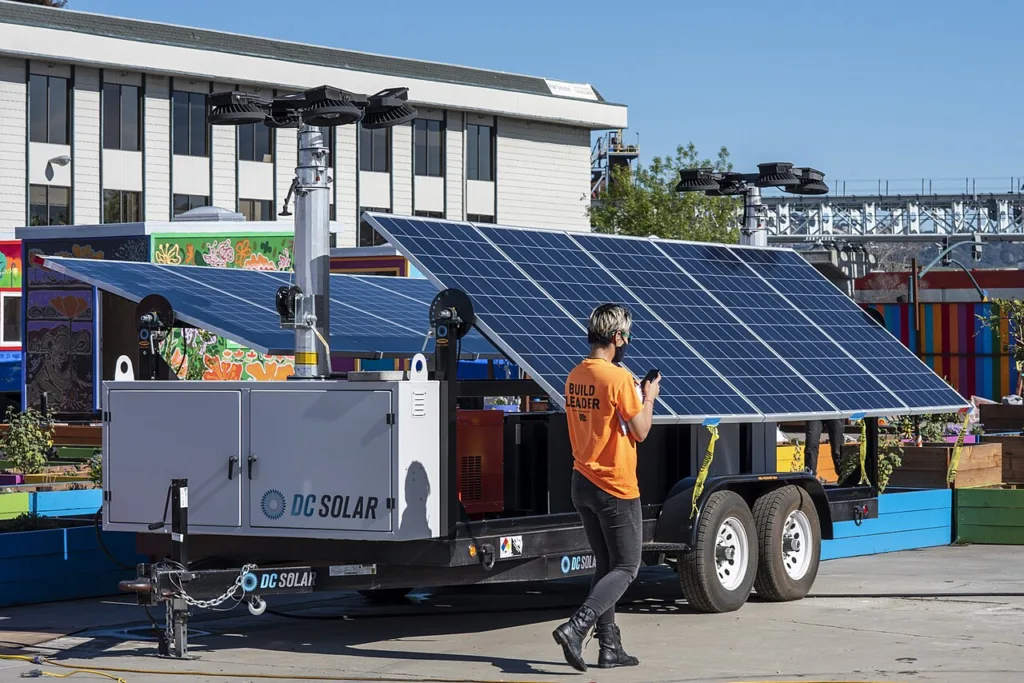
A long wheelbase van roof typically fits between 400 and 800 watts once you account for vents, fans and a roof rack. A smaller van may only take 200 watts.
Rigid panels last longer. Semi-flexible panels are tempting because they are light and low profile, but bonding them directly to a hot metal roof traps heat, and heat is what kills them. Many fail within a few years. If you use them, leave an air gap.
Mounting without drilling is possible using structural adhesive tape with brackets, and it is common practice. Drilling with properly sealed fixings is also fine. What matters is that the sealant is suitable for the roof material and gets inspected annually.
Assume you will get roughly three to five useful sun hours per day in summer and far less in winter at high latitudes. A 400 watt array might return 1,200 to 2,000 watt-hours on a good summer day and a few hundred on a grey December one.
Three charging sources, not one
The most reliable van systems do not rely on solar alone.
Solar. Free, silent, works while parked. Weak in winter and useless in dense forest.
Alternator via a DC to DC charger. This is the component most first builds omit. It charges the house battery properly while you drive, at a controlled rate that protects both the alternator and the lithium bank. On a travel day it can deliver more energy than the panels do in three days of winter sun. Never connect a lithium house bank to a modern alternator without one.
Shore power. A mains charger for campsites and driveways. Cheap insurance for long stationary periods.
Use an MPPT controller rather than PWM. Standard panels have far higher voltage than a 12V bank, which is exactly the case where MPPT recovers the most. See MPPT versus PWM.
Common mistakes
Buying panels first. The battery and the energy budget determine the array, not the other way round.
Skipping the DC to DC charger. It is the single best upgrade for anyone who drives regularly.
Undersizing cable. Low voltage means high current. Voltage drop on thin cable wastes real energy and creates heat.
Gluing flexible panels flat to the roof. Trapped heat shortens their life dramatically.
Planning for air conditioning. It is achievable but it needs a very large bank and array, well beyond a typical build.
No fusing at the battery. Every positive cable needs protection close to the source. This is a fire safety issue, not an optional extra.
FAQ
How many watts of solar do I need for a van?
Most builds land between 200 and 600 watts. Calculate your daily watt-hours first, then size the array to replace them in the sun hours you realistically get.
Can van solar run an air conditioner?
Rarely. Air conditioning typically needs a much larger battery bank and array than a van roof and payload allow.
Is lithium worth it over lead acid?
For almost every van, yes. You get roughly double the usable capacity per rated amp-hour at a fraction of the weight.
Do I need a DC to DC charger?
If you have a lithium house bank and want to charge from the engine, yes. Connecting directly can damage the alternator.
Rigid or flexible panels?
Rigid panels last much longer. Flexible panels suit curved roofs but need an air gap to survive.
Will solar work in winter?
Poorly at high latitudes. Plan on the alternator and shore power carrying the winter load.
What size inverter do I need?
Size it to your largest simultaneous AC load. Many vans need no inverter at all if appliances run on 12V.
Where to go next
Read the RV solar guide for larger vehicles, off-grid kits for pre-matched components, and portable solar chargers for supplementary power.
Component and safety background is published by the National Renewable Energy Laboratory.
Related Posts


Leave a Comment
Your comment will be published after it has been approved. Please send comments that do not contain slang words.