
Generac PWRcell vs Powerwall, Enphase and a Standby Generator
Quick answer: The PWRcell is a modular DC-coupled battery built around a hybrid inverter, so you buy capacity in blocks and expand later. That modularity is its real advantage over fixed-capacity rivals. The more useful comparison for most homeowners is not PWRcell versus Powerwall, but battery versus standby generator, and the honest answer depends on how long your outages last.
What this guide covers
- How the PWRcell is put together
- How it compares with the main rivals
- Battery versus standby generator
- Sizing it for your actual outage
- Retrofitting onto existing solar
- Common mistakes
- FAQ
How the PWRcell is put together
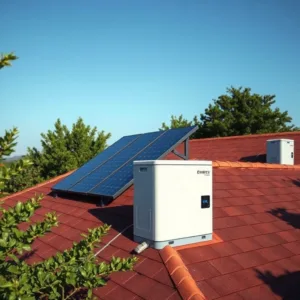
The system is built from three parts. A hybrid inverter, a battery cabinet holding stackable modules, and load management hardware that decides what stays on during an outage.
Capacity is added in modules rather than in whole units. You start with a partly filled cabinet and add modules later as budget or need grows. Most competing products are sold as a fixed block of energy.
The system is DC coupled. Solar charges the battery on the direct current side, without converting to alternating current first. That is slightly more efficient for charging than an AC-coupled design.
Rapid shutdown is handled by module-level devices on the roof, which satisfies the code requirement that every rooftop array must meet.
Load management is the part buyers underrate. A controller that can shed a heat pump or an oven during an outage lets a smaller battery back up a whole panel instead of a small critical-loads subpanel.
How it compares with the main rivals
| System | Coupling | Expandability | Best fit |
|---|---|---|---|
| Generac PWRcell | DC | Module by module | New solar plus storage, staged budget |
| Tesla Powerwall | AC, newer units integrate solar | Whole units | Simple whole-home backup |
| Enphase IQ Battery | AC | Small increments | Retrofits, existing Enphase arrays |
| SolarEdge Energy Bank | DC | Limited | Existing SolarEdge systems |
| Standby generator | Not applicable | Fuel limited only | Long multi-day outages |
Chemistry is worth asking about directly. Some home batteries use lithium iron phosphate, which trades a little energy density for a longer cycle life and better thermal behaviour. Others use nickel-based chemistries that pack more energy into the same cabinet. Ask which one you are being quoted, and see solar battery chemistry.
Battery versus standby generator
This is the decision that actually matters, and the answer turns on outage duration.
A battery is silent, needs no fuel, requires almost no maintenance, and earns money every single day by shifting energy away from expensive hours. Its weakness is duration. Once it is empty, you wait for the sun.
A standby generator runs as long as it has fuel. That makes it the stronger choice for genuinely long outages, such as multi-day storm events. Its weaknesses are noise, fuel supply, exercise cycles and annual servicing. It also does nothing for you on the 360 days a year when the power stays on.
If your outages last hours, buy a battery. If they last days and happen every winter, a generator is the more honest answer. Some households with both use the battery for daily savings and short cuts, and the generator for the rare long event.
Compare the running economics in energy storage versus generator.
Sizing it for your actual outage
Do not size against total daily consumption. Size against what you actually need to run when the grid is down.
List the loads you genuinely need. A refrigerator, some lighting, internet, phone charging, a well pump if you have one, and medical equipment if applicable. Add the watt-hours across the hours you need them.
Then decide whether heating or cooling is on that list. Air conditioning and resistance heat are enormous loads and they change the answer completely. A heat pump running through a summer night can consume more than the rest of the house combined.
Surge matters too. Well pumps and compressors draw several times their running current at startup. The inverter’s surge rating decides whether the system can actually start them.
Our storage sizing guide works through the arithmetic.
Retrofitting onto existing solar
A DC-coupled system is designed to be installed with the solar, because the battery and the array share an inverter.
Adding one to an existing array usually means replacing the existing inverter. That is a real cost and it may waste equipment that still has years of warranty left.
AC-coupled batteries avoid that. They sit alongside whatever inverter you already have. If your solar is already in place, AC coupling is normally the cheaper path even if it is a fraction less efficient.
Get both quoted. The efficiency difference is small. The inverter replacement cost is not.
Common mistakes
Buying capacity instead of load management. Shedding a few big loads often backs up the whole house more cheaply than adding modules.
Ignoring the transfer switch scope. Confirm in writing whether the backup covers the whole panel or only a critical-loads subpanel.
Forgetting the battery cannot start the well pump. Check surge ratings against your actual motor loads.
Assuming solar keeps working during an outage. Without a battery or an islanding-capable inverter, a grid-tied array shuts down when the grid does.
Skipping the warranty throughput clause. Battery warranties limit years and total energy throughput. Read both numbers. See storage warranties.
FAQ
Is the PWRcell better than a Powerwall?
Neither is better outright. The PWRcell’s modular capacity suits staged budgets and new installs. A fixed-capacity unit is simpler when you want whole-home backup in one purchase.
Can I add a PWRcell to an existing solar system?
Usually it means replacing the existing inverter, because the design is DC coupled. An AC-coupled battery is normally cheaper as a retrofit.
How much backup capacity do I need?
Size against the loads you must run during an outage and the hours you must run them, not against total daily household consumption.
Does a home battery replace a generator?
For outages lasting hours, yes. For multi-day outages, a generator still wins because it runs as long as it has fuel.
What warranty should I expect?
Home batteries typically carry warranties around ten years, limited by both time and total energy throughput. Check which limit you would hit first.
Will the battery pay for itself?
That depends on your tariff. Where the peak-to-off-peak price spread is wide, daily arbitrage builds real value. Where it is flat, the battery is mostly buying resilience.
Can it charge from the grid?
Most systems can, which matters when you want a full battery before a forecast storm. Confirm the setting is available on your configuration.
Where to go next
Read the home storage guide, Powerwall alternatives and hybrid inverters for the inverter side of the decision.
Independent storage performance research is published by the National Renewable Energy Laboratory.
Related Posts
Leave a Comment
Your comment will be published after it has been approved. Please send comments that do not contain slang words.