
Marine Solar Panels for Boats: Corrosion, Shading and Real Output
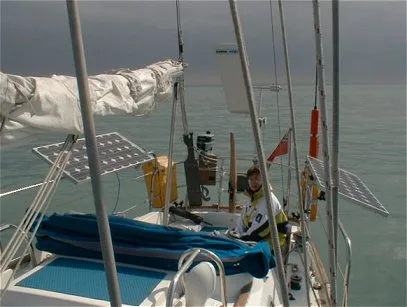
Quick answer: A boat is the harshest environment a solar panel can live in. Salt, constant motion, and shade from rigging that sweeps across the array all day. The two decisions that matter most are mounting location, which determines shading, and wiring specification, which determines whether the system survives. Use tinned marine cable and give each panel its own controller or a shade-tolerant architecture.
What this guide covers
- Why shading is the dominant problem
- Mounting options compared
- Where to put the panels
- Corrosion and marine wiring
- Realistic output at anchor
- Common mistakes
- FAQ
Why shading is the dominant problem
On a house roof, shade is a fixed problem you design around once. On a sailboat the mast, boom, rigging and sail sweep shadows across the panels continuously as the boat swings at anchor.
This matters more than most owners expect because of how panels are wired internally. A shadow across one cell can cut the output of a whole panel disproportionately, and in a series string it drags down the other panels too.
There are two practical answers. Give each panel its own charge controller, so a shaded panel cannot pull down its neighbours. Or wire panels in parallel rather than in series, which limits the damage to the shaded panel alone.
Parallel wiring means higher current and therefore thicker cable, which is a cost worth paying on a boat. Bypass diodes in the panel help but they do not eliminate the problem.
Mounting options compared
Stern arch. The best electrical result on most sailing boats. Panels sit high and clear of most shading, and they can be rigid. The cost is a significant structure and added weight aloft.
Rail mounts. Adjustable, tiltable and easy to retrofit. They shade easily, they are vulnerable when berthing, and they take up rail space.
Bimini or dodger. Semi-flexible panels sewn or fastened to fabric. Neat and low profile, but the panels sit on an insulating surface that traps heat, which lowers output and shortens life.
Deck mounted. Walkable semi-flexible panels bonded to the coachroof. Convenient on motorboats, but they are shaded by crew and gear, and heat build-up is again the issue.
On a motor cruiser without a rig, most of the shading problem disappears and a simple hardtop installation works well.
Where to put the panels
| Location | Shading | Cooling | Notes |
|---|---|---|---|
| Stern arch | Low | Good | Best output, highest build cost |
| Rail mount | Medium | Good | Tiltable, exposed when berthing |
| Bimini | Medium | Poor | Neat, shorter panel life |
| Coachroof | High | Poor | Walkable panels, crew shading |
| Hardtop (motor) | Low | Good | Simplest strong option |
Corrosion and marine wiring
This is where boat installations differ most from land installations, and where shortcuts fail fastest.
Use tinned copper cable. Bare copper wicks salt moisture along the strands under the insulation and corrodes from the inside. The failure is invisible until the circuit goes high-resistance and warm.
Crimp, do not solder, for structural connections. Solder creates a stiff point where the wire will eventually fatigue and break from vibration. Use marine-grade crimps with adhesive-lined heat shrink.
Watch dissimilar metals. Stainless fasteners into aluminium frames in salt spray will corrode. Isolate them.
Seal deck penetrations properly. Use a proper deck gland, not sealant alone.
Fuse close to the battery. Every positive conductor needs overcurrent protection near the source. On a boat this is a fire and life-safety issue.
Follow recognised marine electrical standards rather than building practice. The requirements differ for good reasons. Our guide to connector types covers the connector side.
Realistic output at anchor
Set expectations from measured behaviour, not from panel ratings.
A 400 watt array on a well-placed arch might return 1,200 to 1,800 watt-hours on a clear summer day at anchor in the tropics. The same array under a shading rig, at higher latitude, in variable weather, may return a third of that.
The typical boat loads are a fridge, instruments, autopilot, lights and charging devices. A fridge alone often consumes 600 to 1,000 watt-hours a day in warm water.
Most cruising boats find that solar covers daily domestic loads at anchor and reduces engine or generator running significantly, without eliminating it. That is a realistic and worthwhile outcome.
Battery choice matters as much as panels. Lithium iron phosphate accepts charge far faster, which means the array is not wasted on a bank that will only take a trickle by mid-morning.
Common mistakes
Series wiring on a sailboat. One shaded panel drags down the string all day.
Untinned cable. The most common cause of a system that works for two seasons and then does not.
Flexible panels bonded flat to a deck. Heat has nowhere to go and output falls while ageing accelerates.
Ignoring the anchor swing. Test shading through a full 360 degrees, not just at the dock.
Undersized controller for cold snaps. Panel voltage rises when cold. Check the maximum input rating.
No means of isolation. A switch or breaker between array and controller makes servicing safe.
FAQ
How much solar does a cruising boat need?
Calculate daily watt-hours first. Many cruising boats settle between 300 and 800 watts, with the fridge as the dominant load.
Should I wire boat panels in series or parallel?
Parallel, or with a separate controller per panel, because rig shading otherwise drags down the whole string.
Are flexible panels suitable for boats?
They suit curved surfaces and biminis but run hot and typically last far less time than rigid panels.
Why does marine wiring have to be tinned?
Salt moisture wicks into bare copper strands and corrodes them internally, causing hidden high-resistance connections.
Can solar replace the engine or generator?
It usually reduces running time substantially rather than eliminating it, especially if you have refrigeration and high latitude sailing.
Do I need a marine-specific charge controller?
The controller need not be marine branded, but it must be mounted in a dry, ventilated location and wired to marine standards.
How should panels be mounted on a sailboat?
A stern arch gives the best electrical result. Rail mounts are the easiest retrofit. Both beat deck mounting for shading and cooling.
Where to go next
Read MPPT versus PWM for controller choice, off-grid batteries for bank sizing, and van life solar for a closely related build process.
Photovoltaic performance background is published by the National Renewable Energy Laboratory.
Related Posts

Leave a Comment
Your comment will be published after it has been approved. Please send comments that do not contain slang words.