
Bidirectional EV Charging Solar
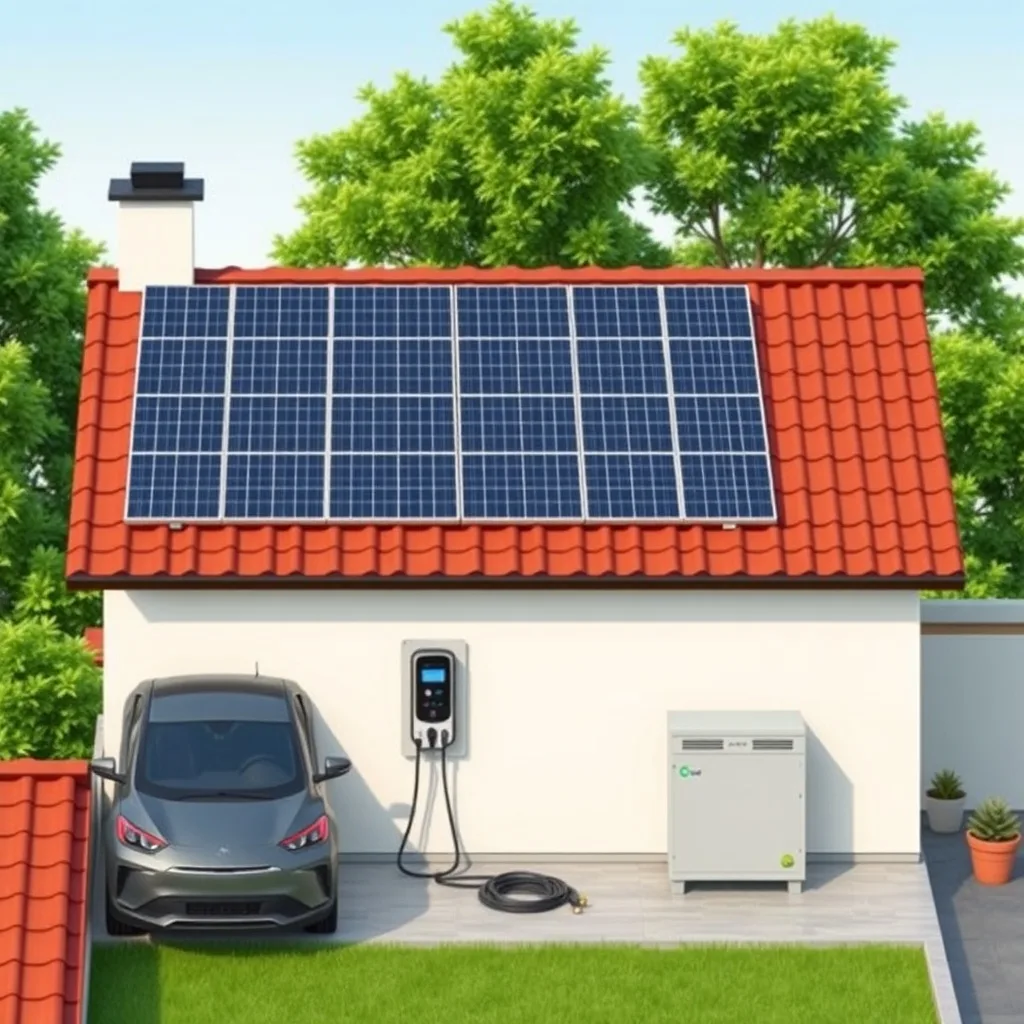
Bidirectional EV charging lets your vehicle’s battery power your home, not just receive power from it — turning a parked EV into a genuinely useful backup power source or grid-support asset. Paired with rooftop solar, it closes the loop: panels charge the car by day, and the car can carry the house through the evening or an outage. This guide explains the modes, the hardware, and the questions to settle before you buy.
Table of Contents
- What Bidirectional Charging Actually Means
- V2H vs V2G
- Applications Compared
- Equipment Requirements
- Frequently Asked Questions
What Bidirectional Charging Actually Means
Standard EV charging only flows power one direction — grid or solar into the vehicle. Bidirectional charging adds the reverse capability: power flowing FROM the vehicle’s substantial battery back OUT to your home or the grid, turning your EV into a mobile, large-capacity battery when parked.
How the power gets out
An EV stores energy as DC. To run household appliances it must be converted to AC, which takes an inverter. That inverter can live in the car, feeding AC out through the charge port or a dedicated outlet, or in a wall unit that takes DC from the vehicle and does the conversion at the house. Where the inverter sits determines which vehicles and chargers work together, which is why compatibility is the first question to ask.
Why it pairs well with solar
A solar array produces most of its energy in the middle of the day, when many households use the least. A stationary battery solves that mismatch by storing midday surplus for the evening. An EV parked at home during the day can play the same role, and its pack is often several times the size of a typical home battery. The U.S. Department of Energy’s Alternative Fuels Data Center explains the basics of home charging equipment that bidirectional systems build on. Our solar EV charging hub collects the related guides.
V2H vs V2G
Vehicle-to-Home (V2H) lets your EV power your house directly, similar to a stationary home battery — genuinely useful during outages given most EV batteries hold far more capacity than a typical home battery. Vehicle-to-Grid (V2G) goes further, letting your EV actually feed power back to the utility grid, participating in grid-support programs similar to a virtual power plant.
V2H in practice
During an outage, a V2H system disconnects the house from the grid with a transfer switch, then lets the car supply the essential circuits or the whole panel, depending on the design. On normal days it can shift household load to the evening, discharging the car after sunset and recharging from solar the next morning. Your driving schedule sets the limit: the car has to be home and plugged in to help.
V2G and the utility
Exporting power to the grid means the inverter must meet the same interconnection rules as a solar inverter, including the grid-support functions in IEEE 1547-2018. It also requires a utility program that pays for the service, and those programs are still limited to specific regions and vehicle models. Where they exist, compensation follows the same logic as a virtual power plant: the utility calls on your battery during peak hours and credits you for the energy or the availability. Our net metering guide covers how exported energy is credited.
Applications Compared
| Application | What It Does | Hardware Needed | Utility Involvement |
|---|---|---|---|
| Vehicle-to-Home (V2H) | Powers your home directly, backup power source | Bidirectional charger or vehicle inverter, transfer switch, compatible EV | Permit and inspection; no export program required |
| Vehicle-to-Grid (V2G) | Feeds power back to utility grid, grid-support programs | Grid-interactive bidirectional charger, metering, compatible EV | Interconnection agreement and an active V2G program |
| Vehicle-to-Load (V2L) | Powers external devices/tools directly from the vehicle | Built-in outlet or adapter on the vehicle only | None |
| Vehicle-to-Building (V2B) | Fleet vehicles support a commercial building’s load | Multiple bidirectional chargers, building energy management | Often part of a demand-charge strategy |
V2L is the simplest entry point and is already built into a number of EVs. It runs a power tool, a fridge, or camping gear, but it does not connect to house wiring. V2H and V2G are where the real value and the real cost sit. Our energy storage hub compares the stationary alternatives.
How much of the house can the car run?
Two limits apply. The first is energy: how many kilowatt-hours the pack holds and how much charge you are willing to give up before your next drive. The second is power: how many kilowatts the inverter can deliver at once. Most bidirectional systems supply enough power to run lighting, refrigeration, electronics, and a furnace fan comfortably. Central air conditioning, electric ranges, and clothes dryers are the loads that strain the limit, so many installs put those on a non-backed-up sub-panel. Ask the installer to walk through the backed-up circuits before the transfer switch is wired.
Thinking about cost
Compare the bidirectional charger against a standard Level 2 charger plus a stationary battery of similar usable capacity. If you already plan to buy an EV that supports the feature, the bidirectional charger is often the cheaper route to backup power. If your car is away from home most days, a stationary battery gives more reliable coverage. The AFDC page on EV basics is a good starting point for understanding battery capacity ranges across current models.
Equipment Requirements
Bidirectional charging requires both a compatible vehicle (not all EVs support it) and a bidirectional-capable charger/inverter setup, typically more expensive than standard one-way home charging equipment. This is still an emerging feature set, expanding across more vehicle models but not yet universal.
The checklist
Confirm the vehicle supports bidirectional operation and in which mode. Confirm the charger is certified to work with that specific vehicle; certification is per model, not universal. Confirm your electrical panel has capacity for the charger circuit and room for a transfer switch. Confirm the installer has done a bidirectional install before. Finally, read the vehicle warranty for any limit on discharge cycles used for home or grid supply.
Electrical and permitting
A Level 2 circuit for the charger is only the start. The AFDC’s overview of charging infrastructure development describes the permitting and utility coordination that applies. Many homes also need a load-management device so the charger, heat pump, and other large loads do not exceed the service rating at once. Our EV charger load management guide explains the options.
Battery wear
Every charge and discharge cycle contributes to battery aging, but shallow daily cycling for home use is gentler than fast charging or deep discharge. Manufacturers that offer V2H generally define how much bidirectional use the warranty covers. Read that section before signing up for a grid program. Our battery degradation guide explains what drives wear.
Connector standards
In North America, bidirectional products are appearing for both the CCS connector and the J3400 (NACS) connector, and some vehicles offer AC output through their own onboard inverter instead. Check which standard your car and charger use before assuming they will talk to each other, because a charger built for one connector will not work with the other without a certified adapter.
Frequently Asked Questions
Can any EV do bidirectional charging?
No, only specific compatible vehicle models, plus a bidirectional-capable charger — check compatibility before assuming this feature is available.
Is V2H the same as having a home battery?
Similar function, using your EV’s battery instead of a dedicated stationary unit — often with even larger available capacity.
Does using my EV for home backup damage the battery?
Manufacturers designing for V2H generally account for this in warranty terms, though check your specific vehicle’s documentation.
Can I make money with V2G programs?
Some utility V2G programs offer compensation for grid-support participation, similar to virtual power plant programs, where available.
Is bidirectional charging equipment expensive?
Yes, typically a meaningful premium over standard one-way charging equipment, reflecting the added technology.
Can bidirectional charging work without solar?
Yes — the car can charge from the grid overnight and power the home during peak hours or outages, but solar lets the car recharge during a long outage.
For standard one-way home charging setup, see our solar powered EV chargers guide. For the stationary battery equivalent, see our energy storage system comparison.
See our solar EV charging speed limits guide for how this plays out in practice. Our solar EV charging stations guide works through the details.
Related Posts


Leave a Comment
Your comment will be published after it has been approved. Please send comments that do not contain slang words.