
Utility scale energy storage

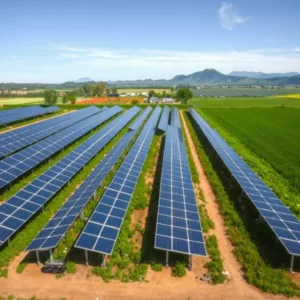
Utility-scale battery storage pairs with large solar farms to shift production to evening peak demand and stabilize grid output — a genuinely different scale and purpose than home battery storage.
Table of Contents
- Why Storage Pairs With Utility Solar
- Key Functions at Grid Scale
- Functions Compared
- The Economics of Co-Located Storage
- Frequently Asked Questions
Why Storage Pairs With Utility Solar
Solar production peaks midday, but grid demand typically peaks in early evening — a mismatch known as the “duck curve.” Co-located battery storage captures midday solar excess and discharges it during the evening peak, making solar generation far more valuable to the grid than it would be exporting directly at the moment of production.
Key Functions at Grid Scale
Beyond simple time-shifting, utility-scale storage provides frequency regulation (rapid response to grid stability needs), capacity value (guaranteed available power during peak demand, reducing need for peaker plants), and ramping support as solar output changes with cloud cover or sunset.
Functions Compared
| Function | Grid Value |
|---|---|
| Time-shifting (duck curve) | Moves midday solar to evening peak demand |
| Frequency regulation | Rapid response supporting grid stability |
| Capacity value | Guaranteed power availability, reduces peaker plant need |
| Ramping support | Smooths output changes from clouds/sunset |
The Economics of Co-Located Storage
Co-locating storage with a solar farm shares interconnection infrastructure and land, reducing total project cost compared to building each separately. Storage also lets developers capture higher-value evening electricity prices rather than selling all production at midday’s typically lower rates, meaningfully improving project economics.
Frequently Asked Questions
Why is utility-scale storage often paired with solar specifically?
It solves the “duck curve” mismatch between midday solar production and evening peak grid demand.
Is utility-scale storage the same technology as home batteries?
Similar lithium chemistry at much larger scale, with additional grid-service functions home batteries don’t provide.
Does storage make solar farms more profitable?
Generally yes, by capturing higher-value evening electricity prices instead of selling all output at midday rates.
What is frequency regulation?
Rapid, automated power adjustments that help keep the grid’s electrical frequency stable in real time.
Do all utility-scale solar farms include storage?
No, but the combination is increasingly standard for new projects given the economic and grid-value benefits.
For the consumer-scale equivalent, see our energy storage system comparison. For the broader utility-scale landscape, see our utility-scale solar guide.
For the full breakdown, see our large scale solar energy guide.
Related Posts

Leave a Comment
Your comment will be published after it has been approved. Please send comments that do not contain slang words.