
Utility-Scale Solar: 7 Essential Insights for Large-Scale Projects
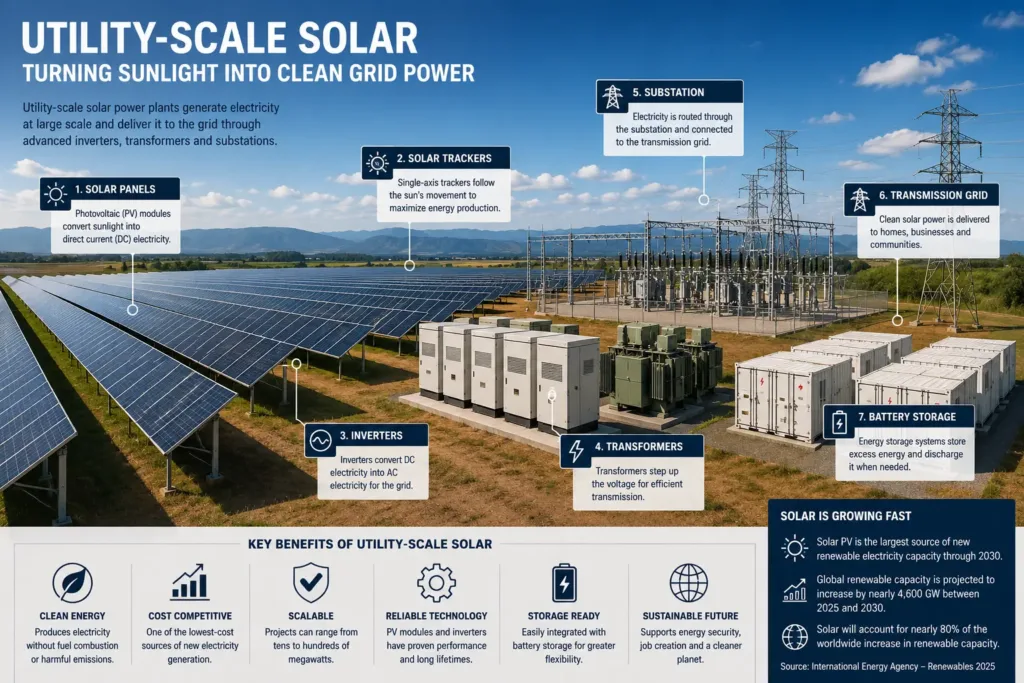
Utility-scale solar is one of the most important forms of new electricity generation in the global energy transition. Unlike residential and small commercial solar systems, utility-scale photovoltaic (PV) projects are designed primarily to generate electricity for the electrical grid.
A modern utility-scale solar farm can combine large arrays of PV modules with single-axis trackers, solar inverters, medium-voltage collection systems, transformers, substations, monitoring equipment, plant controllers, forecasting systems and increasingly battery energy storage systems.
The global market continues to expand rapidly. The International Energy Agency’s Renewables 2025 outlook projects almost 4,600 GW of new renewable power capacity between 2025 and 2030, with solar PV accounting for nearly 80% of worldwide renewable electricity capacity expansion. The IEA also identifies grid integration, supply-chain risks and financing as important challenges during this growth phase. IEA Renewables 2025
Key takeaway: A competitive utility-scale solar project is not defined by PV module efficiency alone. Site selection, energy yield, DC-to-AC ratio, inverter architecture, grid interconnection, transmission, storage, financing, construction and long-term operations all influence project performance.
Table of Contents
- What Is Utility-Scale Solar?
- How Does a Utility-Scale Solar Power Plant Work?
- PV Modules in Utility-Scale Solar
- Solar Trackers and Mounting Systems
- Utility-Scale Solar Inverters
- DC-to-AC Ratio and Inverter Loading Ratio
- How Much Does Utility-Scale Solar Cost?
- What Is LCOE?
- Capacity Factor and Energy Yield
- Why Site Selection Matters
- Grid Interconnection
- Utility-Scale Solar Plus Battery Storage
- EPC and Construction
- Operations and Maintenance
- SCADA, Forecasting and Plant Controls
- Advantages and Challenges
- Utility-Scale Solar Project Development
- The Future of Utility-Scale Solar
- Frequently Asked Questions
What Is Utility-Scale Solar?
Utility-scale solar refers to large photovoltaic electricity-generation facilities that primarily supply power to an electrical grid. Solar modules generate direct current (DC), inverters convert that DC electricity into alternating current (AC), transformers increase the voltage, and the plant substation transfers electricity to the grid.
There is no single global megawatt threshold that defines utility-scale solar. Different countries, regulators, utilities and research organizations use different definitions. The term generally describes centralized solar generation that serves the grid rather than primarily serving one home, building or small facility.
What makes utility-scale solar different is therefore not only project size. A large solar plant must operate as an integrated generation asset with electrical protection, monitoring, grid controls, forecasting, commercial contracts, maintenance systems and long-term performance requirements.
| Characteristic | Utility-Scale Solar | Commercial Solar | Residential Solar |
|---|---|---|---|
| Typical scale | Often tens to hundreds of MW | kW to multiple MW | Usually several kW to tens of kW |
| Primary purpose | Grid electricity generation | On-site use and/or export | Household electricity supply |
| Typical site | Large land parcels or dedicated generation sites | Commercial roofs, parking areas or land | Residential roofs or small ground mounts |
| Grid connection | Medium/high-voltage systems and substations | Usually distribution-level | Usually low-voltage or distribution-level |
For an overview of large-scale solar technologies, explore the SolarSunLabs Utility Scale Solar category.
How Does a Utility-Scale Solar Power Plant Work?
The basic energy flow is simple:
Sunlight → PV modules → DC collection → inverters → AC collection → transformers → substation → electrical grid
PV modules convert solar radiation into electrical energy. DC collection equipment aggregates output from module strings. Inverters convert the electricity into AC. Medium-voltage equipment collects power from multiple inverter blocks. Transformers raise voltage, and the substation provides switching, protection, metering and grid-interconnection functions.
Around this electrical path is a control and monitoring layer. Weather stations measure irradiance, temperature and other site conditions. SCADA systems monitor equipment. Plant controllers manage real-time output and grid requirements. Forecasting systems estimate future generation.
The U.S. Department of Energy describes solar integration as the use of technologies and tools that allow solar electricity to connect to the electrical grid while maintaining reliability, security and efficiency. DOE’s work also highlights inverters, energy storage, communication, sensing and control as important elements of modern power-system integration. U.S. Department of Energy — Solar Systems Integration Basics
PV Modules in Utility-Scale Solar
PV modules are the primary electricity-producing components in a solar power plant. However, utility-scale developers do not select modules based only on their headline efficiency.
Important considerations can include temperature coefficient, degradation rate, bifacial performance, mechanical loading, environmental durability, warranty terms, supply availability, manufacturing consistency and compatibility with the selected inverter and mounting architecture.
Bifacial PV Modules
Bifacial modules can generate electricity from light reaching both the front and rear surfaces. The additional production depends on factors such as ground reflectivity, module elevation, row spacing, tracker configuration, shading and site conditions.
This means bifacial gain is not a fixed percentage that applies equally to every project. Developers need site-specific energy models to estimate the actual benefit.
Solar Trackers and Mounting Systems
A solar tracker is a mounting system that changes the orientation of PV modules as the sun moves across the sky. Single-axis trackers are widely used in utility-scale solar because they can increase annual energy capture compared with fixed-tilt systems in many locations.
The benefit of tracking must be compared against additional mechanical equipment, controls, maintenance requirements, wind loading, land layout and potential parasitic energy consumption.
| Mounting System | Main Benefit | Main Consideration |
|---|---|---|
| Fixed Tilt | Simple mechanical architecture | Potentially lower energy yield than tracking |
| Single-Axis Tracking | Higher solar capture in many locations | More mechanical and control complexity |
| Dual-Axis Tracking | Tracks the sun in two dimensions | Higher complexity and cost |
Utility-Scale Solar Inverters
Solar inverters convert DC electricity from the PV array into AC electricity that can be synchronized with the electrical grid.
Inverters influence conversion efficiency, plant availability, maintenance, monitoring, protection and grid-support functionality. Large solar projects may use centralized inverter systems, utility-scale string inverters or other architectures.
Advanced inverter systems can perform functions beyond basic conversion. Depending on the technology and interconnection requirements, they can support reactive power, voltage regulation, frequency response and other grid services.
For additional technical analysis, visit the SolarSunLabs Solar Inverters category.
Central Inverters vs. String Inverters
| Factor | Central Inverter | Utility-Scale String Inverter |
|---|---|---|
| Architecture | Large centralized conversion blocks | Multiple distributed conversion units |
| Equipment count | Fewer large units | More individual units |
| Redundancy | Lower equipment granularity | Higher equipment granularity |
| Maintenance | Fewer major units | More devices to monitor |
There is no universally superior inverter architecture. Project layout, equipment availability, maintenance strategy, site conditions, grid requirements and financial assumptions all influence the decision.
DC-to-AC Ratio and Inverter Loading Ratio
The DC-to-AC ratio, also called the inverter loading ratio (ILR), compares the rated DC capacity of the PV array with the rated AC capacity of the inverter system.
For example, 134 MWdc of PV connected to 100 MWac of inverter capacity produces an ILR of 1.34.
Developers may intentionally use a ratio above 1.0 because solar irradiance is not continuously strong enough to drive all PV modules at their peak rating. Extra DC capacity can therefore increase inverter utilization during more hours of the day.
The trade-off is clipping. When available DC power exceeds the inverter’s maximum AC output, some instantaneous generation cannot be converted into additional AC power.
NREL’s 2024 utility-scale PV baseline uses a 1.34 ILR for its one-axis tracking assumptions. The optimal ratio for an individual project can be different because it depends on solar resource, equipment costs, interconnection limits, curtailment, module characteristics and electricity-market conditions. NREL — 2024 Utility-Scale PV
How Much Does Utility-Scale Solar Cost?
There is no single global cost for utility-scale solar. Installed project cost varies according to equipment prices, labor, financing, site preparation, tracker technology, civil works, electrical infrastructure, interconnection, transmission upgrades and construction conditions.
PV modules are only one part of the total project investment. A useful financial analysis evaluates the complete system and its lifetime energy output.
| Cost Category | Typical Components | Why It Matters |
|---|---|---|
| PV Modules | Modules, transportation and warranties | Major generation component |
| Inverters | Central or string inverter systems | Conversion and grid functionality |
| Structural BOS | Trackers, racking and piles | Highly site-dependent |
| Electrical BOS | Cables, switchgear and transformers | Power collection and transformation |
| Civil Works | Roads, grading, drainage and foundations | Can vary substantially by terrain |
| Substation | Transformers, breakers and protection | Required for grid connection |
| Interconnection | Network upgrades and grid equipment | Can materially change economics |
| EPC | Engineering, procurement and construction | Affects schedule and execution risk |
NREL’s Q1-2025 solar PV benchmark framework, published through the National Laboratory of the Rockies data catalog, separates project costs into equipment, balance-of-system, installation and related categories. NREL Q1-2025 Solar PV System Cost Benchmarks
What Is LCOE in Utility-Scale Solar?
Levelized Cost of Energy (LCOE) is a financial metric used to represent the average lifetime cost of producing electricity from an energy project.
A simplified conceptual formula is:
LCOE = Discounted lifetime costs ÷ Discounted lifetime electricity generation
For utility-scale solar, LCOE can be influenced by capital expenditure, financing assumptions, operating expenses, energy yield, degradation, project lifetime and system performance.
LCOE is useful for comparing generation technologies, but it does not capture every source of electricity-market value. Grid location, transmission constraints, curtailment, generation timing, storage capability and market revenues can influence the commercial attractiveness of a solar project.
Capacity Factor and Energy Yield
Capacity factor compares actual electricity generation with the amount of electricity a power plant would produce if it operated continuously at its rated capacity.
A 100 MW AC solar plant does not produce 100 MW every hour of the year because sunlight changes by hour, season, weather and location.
NREL’s 2024 Annual Technology Baseline gives first-year utility-scale PV capacity-factor estimates from 21.4% to 34.0% across its U.S. solar-resource classes. Those figures are based on specific modeling assumptions and should not be treated as universal values for every project. NREL Utility-Scale PV Capacity Factors
| Performance Factor | Effect on Generation |
|---|---|
| Solar Resource | Determines available solar energy |
| Tracker Configuration | Can improve solar capture |
| Module Technology | Influences efficiency and temperature behavior |
| Bifacial Gain | Can increase output under favorable conditions |
| DC-to-AC Ratio | Influences inverter utilization and clipping |
| Downtime | Reduces available generation |
| Curtailment | Can limit exported electricity |
| Degradation | Reduces lifetime output |
Why Site Selection Matters
Site selection can determine whether a utility-scale solar project is technically and financially viable.
Developers evaluate solar irradiance, land availability, topography, geology, flooding, environmental restrictions, road access, transmission infrastructure, interconnection capacity and local permitting requirements.
A site with exceptional sunlight is not automatically the best project site. A remote location may have excellent solar resources but require expensive transmission upgrades. A slightly less sunny location can be more attractive if it has better grid access, simpler permitting and lower development risk.
| Site Factor | Why It Matters |
|---|---|
| Solar Resource | Influences electricity production |
| Grid Access | Affects interconnection cost and schedule |
| Land Availability | Determines plant footprint and layout |
| Topography | Influences grading and tracker installation |
| Environmental Constraints | Can affect permits and construction |
| Transmission Capacity | Determines potential export capability |
Utility-Scale Solar Grid Interconnection
Grid interconnection is one of the most important technical and commercial considerations in large-scale solar development.
A project must satisfy the requirements of the relevant utility, transmission operator, distribution operator, electricity market or regulator.
Depending on the jurisdiction, requirements can involve voltage control, reactive power, frequency response, fault ride-through, protection, communications, power quality, ramp rates and plant-level controls.
Interconnection studies can identify network upgrades or operating restrictions. Those requirements may affect capital cost, project schedule, commercial operation and the ultimate financial viability of a project.
Why Transmission Matters
High-quality solar resources are not always located close to major electricity demand centers. A project can therefore have excellent solar conditions while facing export limitations because the surrounding transmission network cannot absorb its full output.
As utility-scale solar deployment expands, transmission planning becomes increasingly connected to renewable project development.
Utility-Scale Solar Plus Battery Energy Storage
Combining solar PV with a Battery Energy Storage System (BESS) is becoming increasingly common in large renewable projects.
Solar output is usually strongest during daylight hours. Electricity demand and electricity-market value can be higher during other periods. A battery can store a portion of solar generation and discharge it later, subject to the battery’s operating limits and the project’s commercial structure.
| Feature | Solar PV Only | Solar + BESS |
|---|---|---|
| Capital Requirement | Lower | Higher |
| Energy Shifting | Limited | Yes |
| Dispatch Flexibility | Lower | Higher |
| Operational Complexity | Lower | Higher |
| Battery Degradation | Not applicable | Important design factor |
A battery described as 100 MW / 400 MWh has 100 MW of nominal power capacity and 400 MWh of nominal energy capacity. In a simplified example, that corresponds to four hours of discharge at 100 MW. Actual usable energy depends on state of charge, efficiency, reserve requirements, temperature, usable capacity and degradation.
For more battery-storage analysis, visit the SolarSunLabs Energy Storage Systems category.
What Is EPC in Utility-Scale Solar?
EPC stands for Engineering, Procurement and Construction.
In a utility-scale solar project, EPC execution turns the technical design into a complete and commissioned generating facility.
Engineering
Engineering can include civil design, structural engineering, electrical design, grounding, medium-voltage collection, substation design, communications, controls, roads, drainage and equipment layouts.
Procurement
Procurement covers major project equipment such as PV modules, trackers, inverters, transformers, switchgear, cables, monitoring systems and communications hardware.
Construction
Construction can include site preparation, pile installation, tracker assembly, module installation, DC collection, inverter installation, medium-voltage systems, substation construction, testing and commissioning.
EPC quality has a direct effect on project schedule, commissioning, equipment integration and long-term reliability.
Operations and Maintenance for Utility-Scale Solar
Utility-scale solar plants are designed for long operating lives, making operations and maintenance important to lifetime project economics.
- PV module inspections
- Electrical testing
- Inverter monitoring and repair
- Tracker inspection and maintenance
- Vegetation management
- Thermal imaging and electrical diagnostics
- Substation and transformer inspections
- SCADA monitoring
- Preventive maintenance
- Corrective maintenance
- Performance-ratio analysis
- Availability analysis
Modern O&M teams increasingly use remote monitoring and automated diagnostics. The objective is not only to repair failed equipment but also to detect abnormal performance early enough to reduce energy losses and downtime.
SCADA, Forecasting and Plant Controls
SCADA stands for Supervisory Control and Data Acquisition.
SCADA systems provide operational visibility across large solar farms. Depending on the plant architecture, operators can monitor inverter output, tracker position, weather data, transformer status, switchgear, alarms, communications and other equipment conditions.
Plant-level controllers can coordinate active power, reactive power, voltage behavior and other operating parameters required by the grid connection.
Forecasting is also increasingly important. Grid operators need reliable estimates of expected solar production so that supply and demand can be balanced effectively.
Advantages and Challenges of Utility-Scale Solar
| Advantages | Challenges |
|---|---|
| Large electricity output | Interconnection delays |
| Scalable generation technology | Transmission constraints |
| No fuel combustion during operation | Land and permitting requirements |
| Long operating life | Weather exposure |
| Compatibility with battery storage | Equipment degradation |
| Advanced inverter capabilities | Curtailment risk |
| Low operational fuel cost | Construction and financing risk |
Utility-Scale Solar Project Development
A bankable utility-scale solar project requires technical, environmental, commercial and financial analysis from the earliest stages of development.
- Site identification: Find land with suitable solar conditions and practical grid access.
- Resource assessment: Evaluate irradiance and weather conditions.
- Land and environmental review: Identify permitting requirements and environmental constraints.
- Interconnection analysis: Determine how the plant will connect to the grid.
- Plant design: Select modules, trackers, inverters and electrical architecture.
- Energy modeling: Estimate production, losses, degradation and uncertainty.
- Financial modeling: Evaluate capital cost, operating cost, financing, revenue and LCOE.
- Commercial structure: Evaluate PPAs, utility procurement or merchant-market opportunities.
- EPC contracting: Define engineering, procurement and construction responsibilities.
- Construction: Build the PV plant and grid infrastructure.
- Commissioning: Test equipment, controls, protection and grid compliance.
- Operations: Monitor performance and optimize the plant through its operating life.
These stages are closely connected. A site that looks attractive before an interconnection study can become uneconomic if substantial network upgrades are required. Likewise, a low-cost equipment choice can create higher maintenance costs if reliability is poor.
What Makes a Utility-Scale Solar Project Competitive?
The strongest solar projects optimize multiple variables rather than maximizing one metric.
A high-efficiency PV module cannot compensate for poor transmission access. A low-cost land parcel may not remain attractive if extensive grading is needed. A large battery does not automatically create commercial value if the electricity market cannot reward its operating flexibility.
Developers therefore evaluate energy yield, capital cost, financing, grid value, revenue opportunity, curtailment, storage economics, reliability and lifetime operating performance together.
The Future of Utility-Scale Solar
The next phase of utility-scale solar will be shaped increasingly by integration rather than simply by installing more PV modules.
Advanced inverters, battery storage, grid-forming technologies, forecasting, automated diagnostics, tracker optimization, higher-performance modules and transmission investment are changing how solar plants interact with electricity systems.
| Technology | Role in Future Utility-Scale Solar |
|---|---|
| High-Efficiency PV | More generation from available land |
| Single-Axis Trackers | Improved daily solar capture |
| Advanced Inverters | Conversion and grid-support functions |
| BESS | Energy shifting and operating flexibility |
| Forecasting | Improved generation planning |
| Grid Controls | Better coordination with the power system |
| Transmission | Moves electricity from generation sites to load centers |
The result is a shift from the traditional concept of a solar farm toward an integrated grid asset that can coordinate generation, storage, power electronics, forecasting and intelligent controls.
Frequently Asked Questions About Utility-Scale Solar
What is utility-scale solar?
Utility-scale solar is large-scale photovoltaic electricity generation designed primarily to supply power to the electrical grid. Projects typically include PV modules, inverters, transformers, electrical collection systems, substations and interconnection equipment.
How large is a utility-scale solar farm?
There is no universal size threshold. Definitions vary by country and market. Utility-scale projects are generally much larger than residential or commercial solar systems and commonly operate at tens or hundreds of megawatts.
How does a utility-scale solar farm generate electricity?
PV modules convert sunlight into DC electricity. Inverters convert DC electricity into AC electricity. Transformers increase the voltage, and the plant substation transfers electricity to the grid.
Do utility-scale solar farms use batteries?
Some plants are PV-only, while others combine solar generation with battery energy storage. Batteries can store electricity and discharge it later, subject to system limits and commercial requirements.
What is a solar tracker?
A solar tracker is a mounting system that changes the orientation of PV modules as the sun moves across the sky. Single-axis trackers are widely used in utility-scale projects.
What is the difference between MWdc and MWac?
MWdc represents the rated DC capacity of the PV modules, while MWac represents the AC capacity of the inverter system.
What is the DC-to-AC ratio?
The DC-to-AC ratio compares PV module capacity with inverter AC capacity. Developers often use a ratio above 1.0 to increase inverter utilization, although excessive oversizing can increase clipping.
What is LCOE in solar energy?
LCOE, or levelized cost of energy, represents the average lifetime cost of generating electricity from a project after considering relevant costs and lifetime generation.
Why is grid interconnection important for utility-scale solar?
Grid interconnection determines how electricity can be transferred safely and reliably from the solar plant to the electrical grid. It can affect plant controls, protection, transmission upgrades, project schedules and economics.
What are the biggest challenges facing utility-scale solar?
Major challenges include interconnection delays, transmission constraints, permitting, land requirements, financing, supply-chain risk, equipment reliability, curtailment and long-term operations and maintenance.
What is the main advantage of utility-scale solar?
The main advantage is the ability to generate large quantities of electricity from a scalable renewable energy resource and deliver that electricity directly to the electrical grid.
Conclusion
Utility-scale solar has evolved from a simple photovoltaic generation concept into a sophisticated grid infrastructure technology.
Modern projects can combine PV modules, single-axis trackers, advanced inverters, transformers, substations, SCADA systems, forecasting, plant-level controls and battery energy storage.
The economics of a project therefore depend on much more than module efficiency. Solar resource, land, energy yield, DC-to-AC ratio, grid interconnection, transmission, construction quality, financing, curtailment, storage and long-term maintenance all influence project performance.
As solar deployment continues to grow, the most valuable projects will increasingly be those that integrate generation with storage, transmission, advanced power electronics and intelligent grid controls.
For more large-scale solar analysis, visit SolarSunLabs and explore the site’s Utility Scale Solar category.
Sources and Further Reading
We take this further in our large scale solar energy guide. For the full breakdown, see our utility scale solar vs wind guide.
Related Posts

Leave a Comment
Your comment will be published after it has been approved. Please send comments that do not contain slang words.