
What is a solar inverter

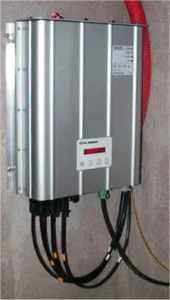
A solar inverter is the component that converts the DC electricity your panels produce into the AC electricity your home actually uses. Without one, solar panels alone can’t power a normal household.
Table of Contents
- The Basic Function
- Types of Solar Inverters
- Types Compared
- Why You Can’t Skip an Inverter
- Lifespan and Replacement
- Frequently Asked Questions
The Basic Function
Solar panels generate direct current (DC) electricity. Homes, and the grid itself, run on alternating current (AC). A solar inverter’s core job is converting one to the other, continuously, as long as the panels are producing power. Beyond that basic conversion, modern inverters also handle safety shutoffs, performance monitoring, and — in hybrid models — battery management.
Types of Solar Inverters
Three main inverter architectures exist today. String inverters are a single central unit handling the whole array. Microinverters attach to each individual panel. Power optimizers sit between the two: they optimize each panel individually but still feed a central string inverter for the actual DC-to-AC conversion.
Types Compared
| Type | Shading Resilience | Relative Cost |
|---|---|---|
| String inverter | Low — one shaded panel affects the whole string | Lowest |
| Power optimizer + string | High — per-panel optimization | Medium |
| Microinverter | Highest — fully independent panels | Highest |
Why You Can’t Skip an Inverter
Without conversion to AC, panel output can’t power standard household outlets, appliances, or lighting, and it can’t be exported to the grid either. The inverter is not an optional add-on — it’s a structural requirement of any grid-connected or AC-load-serving solar system.
Lifespan and Replacement
Most inverters are rated for 10-15 years, noticeably shorter than the 25-year warranty typical for the panels themselves. Budget for one inverter replacement over a system’s full lifetime. Microinverters, since each unit handles less power individually, sometimes carry longer warranties (20-25 years) than a comparable central string inverter.
Frequently Asked Questions
Can solar panels work without an inverter?
Not for powering a normal home — the DC output needs conversion to AC first for household use or grid export.
What’s the difference between a string inverter and a microinverter?
A string inverter handles the whole array centrally; microinverters convert power at each individual panel.
How long do solar inverters typically last?
10-15 years for most string and hybrid inverters, sometimes 20-25 years for microinverters.
Do all inverter types cost the same?
No — microinverters typically cost the most per watt, string inverters the least, with power optimizers in between.
Is a bigger inverter always better?
No — the inverter should be sized to your panel array and household load, not simply maximized.
For a deeper look at each type, see our string inverter vs microinverter comparison. For independent technical background, see Wikipedia’s solar inverter overview.
There is more detail on this in our solar inverter data logging guide. Our solar inverter recall issues guide works through the details.
Related Posts
Leave a Comment
Your comment will be published after it has been approved. Please send comments that do not contain slang words.