
Solar Battery Storage Systems: 7 Powerful Solutions in 2026
Tax timing correction, 30 October 2026: new residential property placed in service after 31 December 2025 is outside Section 25D. Current IRS eligibility and timing guidance. This correction checks the incentive statements only; it is not a new verification of every price, forecast or product claim on this page.
Table of Contents
Comparing specific products? See our Tesla Powerwall alternatives guide for the 2026 model-by-model breakdown.
1. Executive Summary: The Evolution of Solar Energy Storage
When evaluating modern residential and commercial renewable energy infrastructures, installing high-performance solar battery storage systems stands out as the most definitive path toward total power self-sufficiency. Over the past decade, solar panel efficiency has seen steady incremental gains, but the real revolution in decentralized clean power lies in energy retention technology. Without adequate storage, excess daytime photovoltaic generation is frequently throttled, curtailed, or exported back to utility networks at suboptimal feed-in tariff rates.
By pairing photovoltaic arrays with modern solar battery storage systems, property owners convert intermittent daylight into reliable, dispatchable power available 24 hours a day. Whether mitigating extreme grid volatility in California, supporting peak-shaving strategies in Western Europe, or providing rugged off-grid resilience in remote regions across Australia, energy storage technology forms the critical backbone of global power independence.
Historically, residential energy storage was treated as an expensive secondary accessory reserved for remote off-grid cabins. Today, driven by rapid drops in lithium cell manufacturing costs, shifting utility pricing policies, and severe climate-induced grid instabilities, solar battery storage systems have moved to the absolute center of home energy planning. Modern setups do not merely backup essential lighting during blackouts—they dynamically optimize household load profiles, trade energy via virtual power networks, and dramatically cut operational utility expenditures.
Key Industry Insight: Deploying advanced solar battery storage systems allows property owners to increase their solar self-consumption rate from an industry average of 30% to over 85%, creating robust insulation against rising grid tariffs.
2. Why Invest in Solar Battery Storage Systems Today?
Transitioning from traditional grid reliance to self-managed energy infrastructures yields significant financial, operational, and environmental advantages. Utility companies globally are rapidly transitioning toward complex Time-of-Use (TOU) rate structures, heavily penalizing energy consumption during peak evening hours when renewable solar generation drops. Integrating intelligent energy storage directly counteracts these modern cost structures.
Key Advantages of Modern Energy Storage
- Complete Energy Independence: Integrating commercial-grade solar battery storage systems shields households from unexpected utility grid blackouts, micro-grid disruptions, and regional transformer failures.
- Significant Cost Reduction & Arbitrage: Storing free solar electricity generated at noon allows home owners to discharge it during high-cost peak evening windows, eliminating premium utility tariffs.
- Minimized Carbon Footprint: Operating scalable renewable reserves dramatically reduces your reliance on fossil-fuel-powered utility peaker plants during high-demand network cycles.
- Grid Support & Revenue Generation: In many progressive jurisdictions, modern installations can join Virtual Power Plants (VPPs) to earn passive income by stabilizing regional electrical grids during demand spikes.
- Enhanced Property Value: Homes equipped with fully integrated, zero-emission solar battery storage systems command higher real estate market valuations and attract eco-conscious buyers.
As central utility networks age and face increased load demands from electric vehicles (EVs) and heat pumps, home-based energy resiliency is no longer a luxury. Modern solar battery storage systems function as personal electrical substations, ensuring uninterrupted power flow regardless of external weather conditions or grid instability.
3. Chemistry Breakdown: LiFePO4 vs. Traditional Lithium-Ion
When analyzing commercial battery products, understanding internal cell chemistry is critical to maximizing long-term return on investment. The clean energy industry has shifted significantly away from legacy Lead-Acid and Cobalt-based Nickel-Manganese-Cobalt (NMC) chemistries toward Lithium Iron Phosphate (LiFePO4).
According to technical datasheets published by Wikipedia’s Lithium Iron Phosphate Overview, LiFePO4 cells eliminate thermal runaway risks without requiring toxic or ethically questionable cobalt extractions.
Chemical Comparison & Thermal Dynamics
Modern residential solar battery storage systems built on LiFePO4 chemistry offer up to 10,000 operational charge cycles at 80% Depth of Discharge (DoD), whereas standard NMC batteries typically degrade after 3,000 to 4,000 cycles. Furthermore, LiFePO4 units withstand ambient thermal spikes up to 60°C without active cooling failure risk or thermal runaway propagation.
The operational structural advantages of LiFePO4 over traditional chemistries include:
- Chemical Stability: Strong iron-phosphate molecular bonds prevent thermal breakdown under aggressive rapid-charging cycles.
- Non-Toxic Composition: Completely free of rare heavy metals like cobalt or nickel, making disposal and recycling substantially more eco-friendly.
- Constant Voltage Output: Delivers flat discharge curves, providing full rated voltage until the cell is fully depleted.
- Superior DoD Profile: Safely discharges down to 90%-100% capacity without causing permanent crystal structure damage within the cathode.
4. Off-Grid, Grid-Tied, and Hybrid Architectures
Selecting the right power setup depends heavily on local utility regulations, daily electrical load demands, structural wiring setups, and overall property infrastructure:
1. Off-Grid Configurations
Off-grid setups are built for total utility isolation. Equipped with large-capacity battery stacks and high-surge-rated off-grid inverters, these units maintain continuous power for agricultural estates, isolated cabins, and off-grid facilities. They require robust solar arrays to ensure adequate winter charging capacity.
2. Grid-Tied Configurations
These configurations operate in direct tandem with local electrical utility feeds. Excess solar generation charges the storage bank first. Any remaining electricity is exported to the municipal grid under net-metering programs. However, standard grid-tied setups without dedicated backup sub-panels automatically shut down during grid outages for lineman safety.
3. Hybrid System Configurations
Hybrid installations represent the most versatile market segment. They retain utility grid connections for cost-saving energy arbitrage while featuring sub-10-millisecond automatic transfer switches (ATS) for instant emergency backup during severe blackouts.
5. Regional & GEO Performance Insights (US, EU, & Asia-Pacific)
The operational demands placed on clean energy equipment vary drastically by geographic region, climate conditions, structural housing regulations, and local utility incentives:
North America (United States & Canada)
Federal residential incentive eligibility depends on installation date. New home battery property placed in service after 31 December 2025 does not qualify for Section 25D. Check current state and utility program terms separately.
European Union (Germany, Spain, & UK)
European markets prioritize high-efficiency storage solutions due to elevated retail electricity costs and strict energy performance certificates for residential housing. German households overwhelmingly pair rooftop solar installations with high-voltage battery backup to achieve up to 80% self-consumption efficiency.
Asia-Pacific & Australia
Australia boasts the world’s highest rooftop solar penetration per capita. High ambient summer temperatures necessitate robust active thermal management systems and IP66 weatherproofing in all storage units deployed throughout Queensland, Western Australia, and tropical regional zones.
6. Comprehensive Technical Comparison Matrix
Below is a detailed comparative breakdown of top engineering specifications found across modern residential energy storage chemistries:
| Feature / Parameter | LiFePO4 Storage Systems | NMC Storage Systems | Lead-Acid Systems |
|---|---|---|---|
| Expected Cycle Life | 6,000 – 10,000+ Cycles | 3,000 – 4,500 Cycles | 500 – 1,200 Cycles |
| Depth of Discharge (DoD) | 90% – 100% | 80% – 90% | 50% |
| Round-Trip Efficiency | 95% – 98% | 89% – 93% | 75% – 85% |
| Thermal Safety Profile | Exceptional (Non-Combustible) | Moderate (Requires BMS Cooling) | Low (Outgassing Risk) |
| Average Lifespan | 15 – 20 Years | 10 – 12 Years | 3 – 5 Years |
| Energy Density | Moderate-High (140-170 Wh/kg) | High (200-250 Wh/kg) | Very Low (30-50 Wh/kg) |
| Maintenance Requirements | Zero Servicing Required | Zero Servicing Required | Regular Fluid Check / Venting |
7. How to Calculate Exact Capacity Requirements
Sizing storage equipment correctly prevents both premature cell degradation and unnecessary hardware overspending. Follow these structured engineering steps to calculate your target capacity in kilowatt-hours (kWh):
- Determine Daily Consumption: Review your electric utility statements over 12 months to find average daily consumption (e.g., 30 kWh/day).
- Identify Essential Critical Loads: Isolate critical circuits (refrigeration, LED lighting, medical equipment, water pumps, HVAC). If critical loads total 12 kWh per day, your baseline solar battery storage systems capacity must cover this duration minimum.
- Factor in Depth of Discharge (DoD): To maintain long-term cell health and account for non-discharge reserves, apply a buffer multiplier:
$$\text{Target Capacity (kWh)} = \frac{\text{Required Energy Load (kWh)}}{\text{DoD Percentage}}$$ - Account for Inverter Efficiency Losses: DC-to-AC conversion incurs a 3% to 7% energy loss. Ensure your system compensates for conversion overhead by adding a 1.1x scaling factor to final storage sizing.
Example Calculation: For a home requiring 10 kWh of emergency nighttime power using a LiFePO4 battery (90% DoD) and a 95% efficient inverter:
$$\text{Required Capacity} = \frac{10\text{ kWh}}{0.90 \times 0.95} = 11.69\text{ kWh}$$
Therefore, installing a standard 12 kWh to 14 kWh modular battery stack is recommended.
8. 7 Powerful Solar Battery Solutions for 2026
When selecting renewable power reserves for residential or light commercial properties, consider these seven market-leading structural configurations:
1. High-Voltage Modular LiFePO4 Stacks
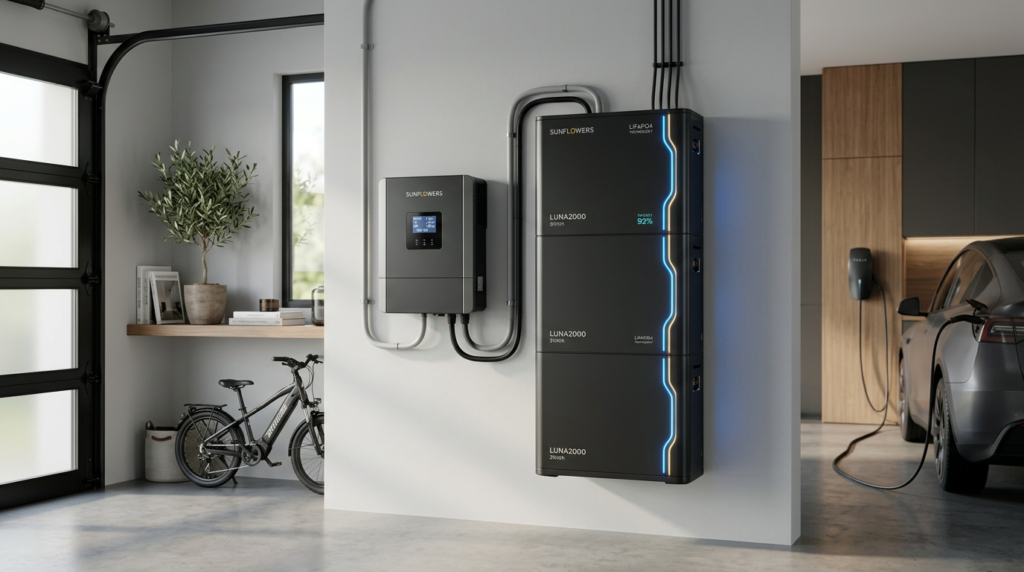
Modular high-voltage units allow homeowners to start with a modest 5 kWh base unit and expand seamlessly up to 40 kWh as household energy demands grow over time. High-voltage architecture (300V+) reduces cable transmission loss and increases overall inverter efficiency.
2. Integrated All-in-One Inverter Cabinets
Combining hybrid inverters, solar charge controllers, and battery modules into a single IP65-rated outdoor cabinet simplifies installation labor, streamlines warranties, and optimizes indoor property footprint utilization.
3. High-Surge Off-Grid Power Stations
Designed for remote off-grid environments and rugged agricultural installations, these heavy-duty systems provide massive surge power capacity (200% continuous rating) to start high-inductance electric motors, air compressors, and well pumps effortlessly.
4. AC-Coupled Retrofit Battery Storage Packs
If you already own an existing rooftop solar panel array, AC-coupled equipment can be retrofitted directly into your main electrical distribution board without altering or replacing your existing string inverter infrastructure.
5. Ultra-Compact Wall-Mounted Power Banks
Ideal for modern urban residences with limited floor space, wall-mounted storage units deliver sleek aesthetic integration, built-in thermal heatsinks, and exceptionally high volumetric energy density.
6. Scalable Commercial Microgrid Arrays
Designed for commercial facilities and industrial parks, these large-scale energy storage arrays scale from 100 kWh up to multi-megawatt configurations, enabling effective demand-charge management and facility backup power.
7. Dual-Fuel Hybrid Storage Generators
Merging solar storage stacks with automatic generator auto-start relays ensures continuous uninterrupted power supply during prolonged multi-week grid failures caused by natural disasters.
9. Financial Analysis, ROI, and Incentive Structures
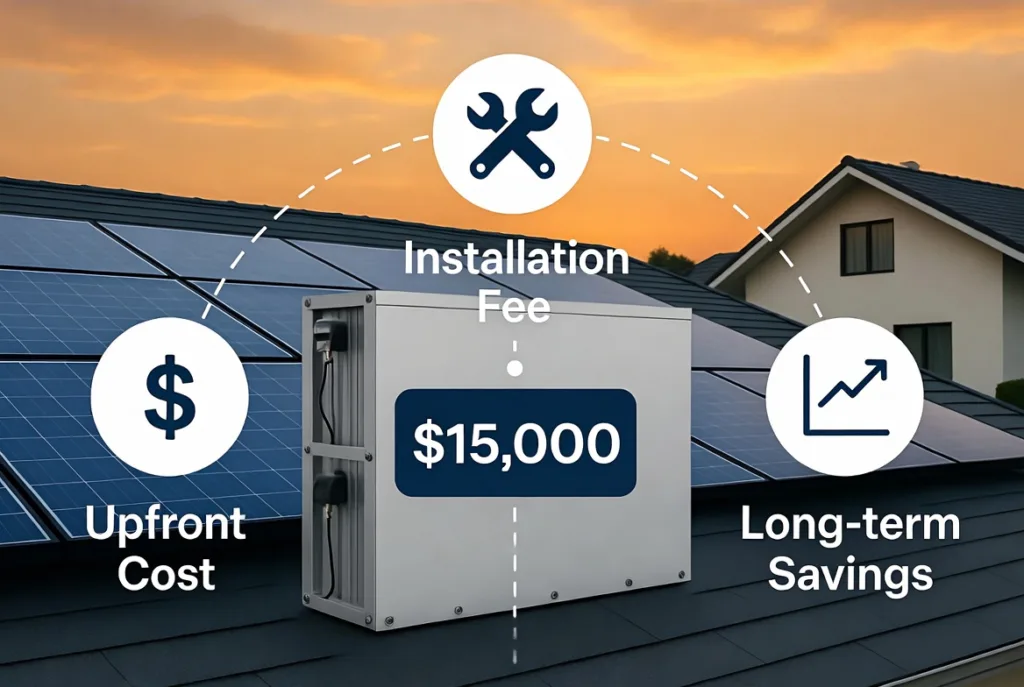
While the upfront turnkey investment in premium residential solar battery storage systems ranges from $5,000 to $18,000 depending on total capacity, smart BMS controls, tax credits, and utility bill savings accelerate the overall payback period significantly. In high-tariff regions, financial break-even is frequently reached within 5 to 7 years.
To maximize total Return on Investment (ROI), property owners should combine the following financial instruments:
- Residential incentives: do not subtract a blanket 30% federal credit for new 2026 home battery installations. The federal residential credit ended for property placed in service after 31 December 2025; state and utility offers have their own eligibility rules.
- Time-of-Use Arbitrage Savings: Offsetting expensive peak utility rates ($0.45+/kWh) using self-stored midday solar energy.
- Virtual Power Plant (VPP) Grid Services: Receiving ongoing monetary credits from utility companies in exchange for releasing surplus stored battery power during regional emergency spikes.
- Net Metering Optimization: Retaining full value for generated solar power rather than exporting excess energy at minimal feed-in rates.
10. Maintenance, Thermal Management, and Safety Standards
Ensuring your clean energy storage system operates safely over a 20-year lifespan requires adhering to strict installation standards, active electrical safety protocols, and environmental controls. Modern lithium iron phosphate batteries require zero fluid topping or active mechanical maintenance, but proper system monitoring remains essential for cell longevity.
Key Safety and Maintenance Rules
- Maintain Ambient Temperature Controls: Ensure storage units are installed in well-ventilated garage spaces or shaded external walls protected from direct summer sunlight and extreme freezing conditions.
- Monitor State of Charge (SoC): Avoid leaving battery banks completely discharged (0% SoC) for extended winter periods to prevent cell voltage drops below recoverable thresholds.
- Verify System Certifications: Ensure equipment meets international safety compliance standards, including UL 1973, UL 9540, and CE certifications for thermal run-away containment.
- Perform Regular Firmware Updates: Smart Battery Management Systems (BMS) regularly receive over-the-air cloud updates that refine charging algorithms, enhance balance monitoring, and improve overall system round-trip efficiency over time.
11. Future Trends in Residential Power Storage Technology
The clean energy landscape is evolving rapidly with continuous technological breakthroughs in solid-state cell chemistry, smart grid software integration, and AI-driven predictive energy management systems. Looking ahead, solar battery storage systems will play a central role in connecting electric vehicles (EVs) directly to residential power grids via Vehicle-to-Home (V2H) and Vehicle-to-Grid (V2G) bidirectional charging protocols.
Furthermore, machine learning algorithms integrated directly into modern hybrid inverters will automatically predict hyper-local weather patterns, dynamic real-time electricity market prices, and household consumption trends to optimize battery charging and discharging cycles in real time.
12. Frequently Asked Questions (FAQ)
How long do modern energy storage systems last?
Modern LiFePO4 storage units typically last between 15 and 20 years, retaining over 70% to 80% of their initial original capacity after 6,000 to 10,000 continuous charge-discharge cycles.
Can I install battery storage without solar panels?
Yes. Homeowners can install standalone battery storage units purely to perform utility price arbitrage—charging the batteries from the electrical grid during cheap off-peak night hours and discharging them during expensive peak evening hours to save money.
Are indoor battery installations safe?
LiFePO4-based energy storage systems are completely safe for indoor garage, utility room, or basement installations because they do not emit hazardous off-gassing and feature extremely high thermal runaway resistance.
What happens to solar battery storage systems during a winter grid failure?
During a winter blackout, a hybrid battery system automatically detaches from the main electrical utility grid via an automatic transfer switch (ATS) in less than 10 milliseconds, instantly supplying continuous power to designated critical household circuits without interrupting sensitive electronic devices.
Related Posts
Leave a Comment
Your comment will be published after it has been approved. Please send comments that do not contain slang words.