
Solar Pool Heaters: Sizing, Cost and Why the Cover Comes First
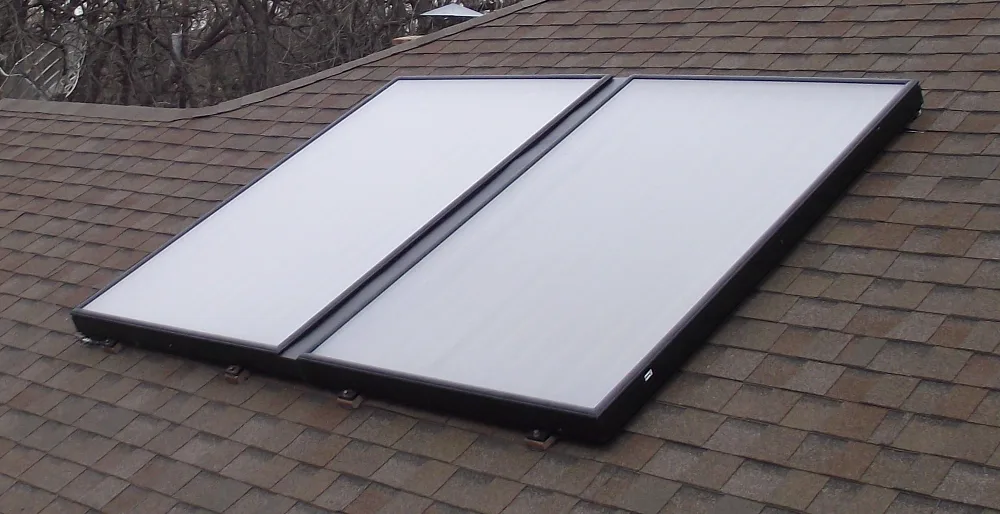
Quick answer: Solar pool heating is the cheapest and fastest-paying solar application most homeowners will ever buy. Unglazed collectors are simple, the water is only heated a few degrees above ambient, and the existing pool pump does the work. Payback is often between two and seven years. Before you buy one, though, fit a pool cover. A cover stops evaporation, which is where most pool heat actually goes.
What this guide covers
- Start with a cover, not a heater
- How solar pool heating works
- Sizing the collector area
- Solar versus gas versus heat pump
- Installation and plumbing
- Realistic season extension
- Common mistakes
- FAQ
Start with a cover, not a heater
Most pool heat does not escape through the walls. It leaves through the surface as evaporation. Turning water into vapour takes an enormous amount of energy, and every gram that evaporates carries heat away.
A pool cover stops that. It is the single most cost-effective pool heating measure available, and it costs a fraction of any heating system.
A cover also multiplies whatever heater you install afterwards. A solar system sized for an uncovered pool will need to be considerably larger and will still lose ground overnight.
Fit the cover first. Then size the solar system against the real remaining gap.
How solar pool heating works
The system is deliberately simple. Your existing pool pump pushes water through a set of collectors, usually on the roof, and the warmed water returns to the pool.
Collectors for pools are unglazed. They are typically black polypropylene mats or tube panels with no glass cover and no insulation. That sounds crude, and it is exactly right for the job.
Pool water only needs to be a few degrees above air temperature. At that small temperature difference, insulation and glazing buy very little, while adding a lot of cost. Unglazed collectors capture a large share of the available energy for very little money.
A diverter valve and a differential controller complete the system. The controller compares collector temperature to pool temperature and opens the valve only when the collectors are warmer.
Sizing the collector area
The standard rule is collector area equal to 50% to 100% of the pool’s surface area.
Use the lower end in hot sunny climates where you only want to extend the season by a few weeks. Use the full 100% or more in cooler climates, for shaded pools, or where you want swimming temperatures in spring and autumn.
Three factors push the number up. A cold or windy site, an uncovered pool, and collectors that cannot face within about 45 degrees of true south. An indoor pool or a spa is a different calculation entirely.
Flow rate matters as much as area. The pump must move the whole pool volume through the collectors several times a day, and the pump must have enough head to lift water to roof height. An undersized variable-speed pump running on its lowest setting will not do it.
Solar versus gas versus heat pump
| Factor | Solar | Gas heater | Heat pump |
|---|---|---|---|
| Running cost | Near zero | High | Moderate |
| Upfront cost | Moderate | Low | Moderate to high |
| Heats on demand | No, weather dependent | Yes, fast | Yes, slower |
| Cold weather | Poor | Excellent | Drops below about 50F |
| Lifespan | 10 to 20 years | 5 to 10 years | 10 to 15 years |
| Maintenance | Very low | Annual service | Moderate |
| Best role | Season extension | Quick heat for occasional use | Steady temperature control |
Many owners combine solar with a small backup heater. Solar carries the load through the shoulder season, and the backup covers the few cold days that matter.
Installation and plumbing
Collectors usually go on a roof, but a rack on the ground or a pool house works just as well if the orientation is right.
The plumbing tees off after the filter and before any existing heater. A three-way diverter valve, either manual or automatic, sends water to the collectors when they are useful and bypasses them when they are not.
Two details cause most failures. First, the collectors must be able to drain when the pump stops, or they will freeze and split in winter. Second, the roof penetrations must be flashed properly, exactly as they would be for photovoltaic racking.
Check your pump curve before committing. Adding roof height and collector resistance increases head. If the existing pump cannot deliver the required flow at that head, a pump upgrade belongs in the budget.
Realistic season extension
Expect a solar system to add roughly four to eight weeks to the swimming season in a temperate climate, split across spring and autumn.
In a warm climate the effect is larger and can approach year-round comfortable temperatures. In a cold northern climate it will not turn a summer pool into a winter one, and no honest installer will promise that.
Temperature lift also matters. A well-sized system typically holds the pool somewhere between 6 and 12 degrees Fahrenheit above what it would otherwise be. Combine that with a cover and the effect roughly doubles.
Common mistakes
Skipping the cover. It is cheaper than the heater and does more work.
Undersizing to save money. A collector area below about half the pool surface rarely produces a noticeable result.
Forgetting winterisation. Collectors must drain before the first freeze, and the diverter must be closed.
Poor orientation. Collectors more than about 45 degrees off south lose a significant share of their output.
Running the pump longer than needed. Extra pumping hours cost electricity. A differential controller avoids that. See smart energy systems for scheduling.
FAQ
How much does a solar pool heater cost?
It varies with collector area and roof complexity, but it is normally the least expensive solar system a homeowner installs, and it typically pays back within two to seven years.
How large should the collector area be?
Between 50% and 100% of the pool’s surface area. Use the higher figure in cooler or windier locations.
How warm will the pool get?
A well-sized system usually raises pool temperature by roughly 6 to 12 degrees Fahrenheit compared with no heating, and more when a cover is used.
Do solar pool heaters work in winter?
Not meaningfully in cold climates. They extend the shoulder seasons rather than creating a winter pool.
Do they need a bigger pump?
Sometimes. Adding roof height and collector resistance increases head, so check the existing pump curve first.
How long do the collectors last?
Unglazed polymer collectors commonly last 10 to 20 years. Ultraviolet exposure is the main ageing factor.
Can I install one myself?
Some kits are designed for it, but roof penetrations, flashing and freeze drainage are easy to get wrong. Poor flashing causes leaks that cost far more than the install saved.
Where to go next
For household hot water rather than pool water, read solar water heaters. To weigh spending the same money on electricity generation instead, see solar panel cost and the payback calculator.
Sizing guidance is published by the U.S. Energy Information Administration.
Related Posts

Leave a Comment
Your comment will be published after it has been approved. Please send comments that do not contain slang words.