
Solar Farm Development
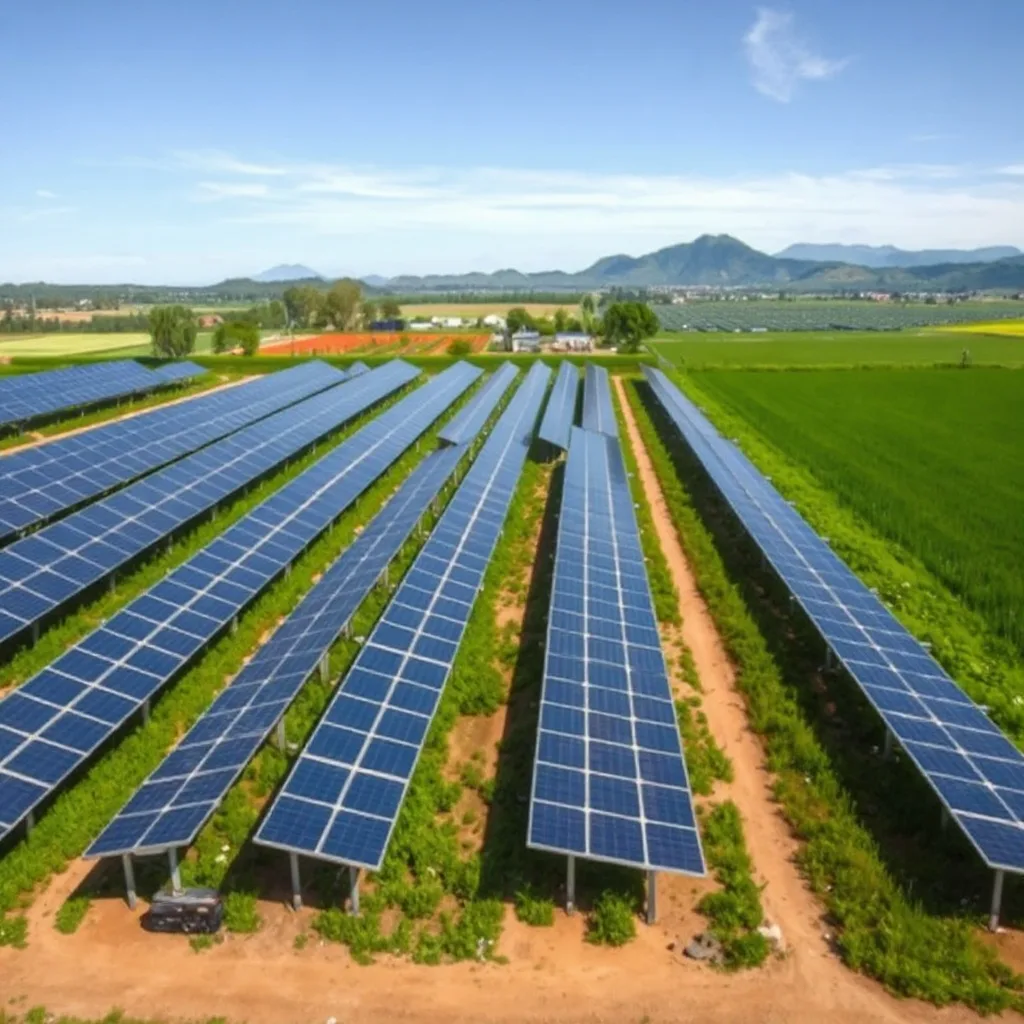
Solar farm development moves from raw land to a producing power plant through a specific sequence most people outside the industry never see — here’s what actually happens at each stage. The visible part, construction, is the shortest. The years before it, when a developer quietly secures land, grid access, permits, and money, decide whether the project ever gets built at all.
Table of Contents
- Early-Stage Development
- Mid-Stage: De-Risking the Project
- Development Stages Summarized
- Who Actually Develops These Projects
- Frequently Asked Questions
Early-Stage Development
Developers first identify promising sites based on solar resource, land cost, proximity to transmission infrastructure, and landowner willingness. Securing land control — through purchase or long-term lease options — happens early, often before other major approvals, since without site control nothing else can proceed.
Reading the solar resource
The first filter is sunlight. Developers use long-term irradiance data to estimate how many kilowatt-hours each installed kilowatt will produce per year. The U.S. Department of Energy explains the underlying measures in its solar radiation basics. A site in the desert Southwest can produce far more per panel than one in the Northeast, but land near cities in sunny states is expensive. The best sites balance resource, land price, and grid access rather than maximizing any one of them.
Finding the grid
A solar farm is only useful if its power can reach customers. Developers map nearby substations and transmission lines and look for spare capacity. A site next to a substation with room for more generation is worth far more than a sunnier site twenty miles from any line. Building new transmission is slow and rarely within a single developer’s control.
Locking up the land
Rather than buying land outright, developers usually sign option agreements. The option gives them the right to lease or buy the parcel at a set price if the project moves forward. The landowner receives a modest annual option payment during development. If the project fails, the option lapses and the land is untouched. The DOE’s farmer’s guide to going solar outlines what landowners should ask before signing. Our guide to utility-scale solar land requirements covers acreage, slope, and soil.
Mid-Stage: De-Risking the Project
This is where interconnection studies, permitting applications, and environmental review all proceed, often in parallel. Developers work to reduce project risk enough to attract financing — a project with secured interconnection and permits is far more financeable than one still working through approvals.
Interconnection: the longest line
The developer files an interconnection request with the regional grid operator or utility. The request enters a queue and goes through a series of studies that estimate what upgrades the grid needs to absorb the new plant and who pays for them. Study results can take years, and upgrade costs sometimes kill projects that looked good on paper. Our utility-scale solar grid interconnection guide walks through the queue process.
Permitting and environmental review
Local zoning approval, state siting permits, stormwater plans, wetland delineation, cultural resource surveys, and wildlife studies all run during this stage. Public hearings give neighbors a voice, and opposition can add months. Projects on federal land or with federal funding also face review under national environmental law. The permitting process guide explains each layer.
Selling the power
Lenders want to know who will buy the electricity before they fund construction. Developers sign a power purchase agreement with a utility, a corporation, or a community solar program, fixing a price per megawatt-hour for 10 to 25 years. Our PPA agreements guide explains the terms. Without an offtake contract, a project can still be built as a merchant plant selling into the wholesale market, but financing is harder and more expensive.
Engineering and procurement
Once the site, grid connection, and buyer are in place, engineers finalize the layout, choose fixed-tilt or tracking racks, select modules and inverters, and issue construction contracts. The DOE notes in its system design basics that tracking increases output at a higher cost, which is exactly the tradeoff designers weigh at this point. Module supply agreements are often signed a year or more ahead of delivery.
Financial close
Financial close is the moment when construction loans and equity are committed and money starts flowing. Lenders sign only after the interconnection agreement, permits, offtake contract, and construction contracts are executed. Tax credit availability matters too; our utility-scale solar tax credits guide tracks the current rules.
Development Stages Summarized
| Stage | Key Activity | Main Risk | Who Is Involved |
|---|---|---|---|
| Site identification | Solar resource, land cost, transmission proximity assessment | Weak resource or no grid capacity | Developer, GIS analysts |
| Land control | Purchase or lease options secured | Landowner declines or title issues | Developer, landowners, attorneys |
| Interconnection | Queue application and grid impact studies | Long delays, high upgrade costs | Grid operator, utility, engineers |
| Permitting and environmental review | Zoning, siting, wildlife, stormwater, cultural surveys | Local opposition, sensitive habitat | Local and state agencies, consultants |
| Offtake | Power purchase agreement signed | No buyer at a workable price | Utilities, corporate buyers |
| Financial close | Construction financing secured, project proceeds to build | Rising interest rates, tax credit changes | Banks, tax equity investors |
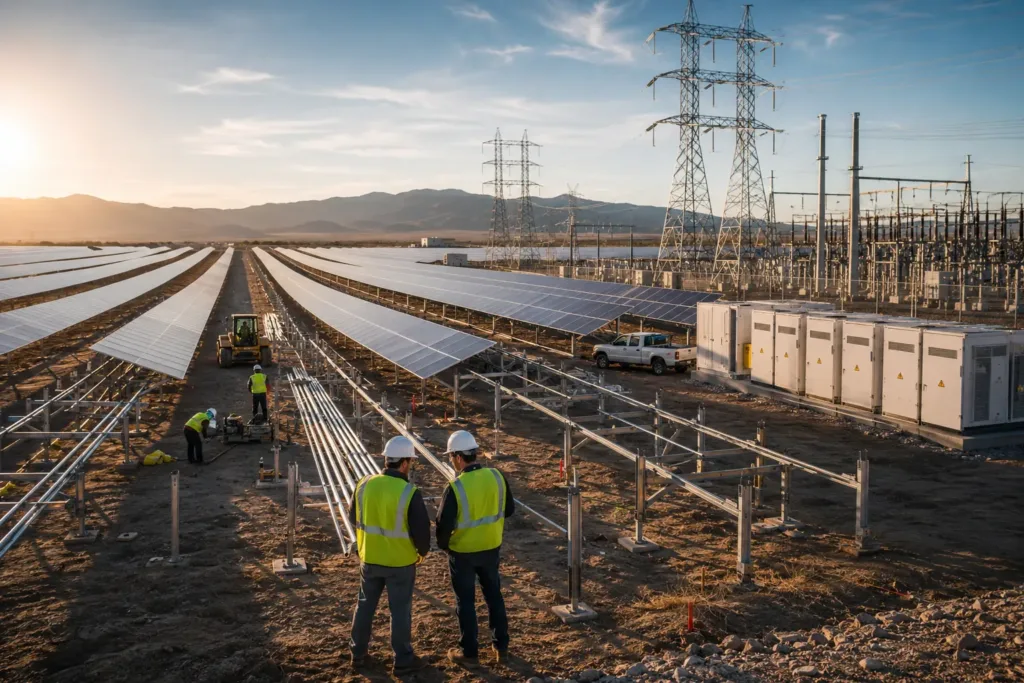
| Construction and commissioning | Site work, racking, modules, inverters, substation, testing | Supply delays, weather, labor | EPC contractor, inspectors |
Most stages overlap. A developer might be negotiating a PPA while the interconnection study is still running and the zoning hearing is scheduled. The construction timeline guide covers the final stage in detail.
Who Actually Develops These Projects
Specialized solar development companies, sometimes independent and sometimes divisions of larger utilities or energy companies, typically originate and manage projects through these early stages, often selling the fully-developed, de-risked project to a long-term owner-operator once it reaches financial close.
Why developers sell before construction
Development is risky and capital-light. Construction and ownership are lower-risk and capital-heavy. Different investors want different parts of that curve. A developer that has spent a few million dollars turning a field into a shovel-ready project can sell it to a utility or infrastructure fund for many times that amount. The buyer gets a project with the hard questions answered and a predictable return.
The wider picture
Utility-scale solar is now the largest source of new generating capacity in many markets. The International Energy Agency’s Renewables 2025 report tracks that growth and the policy and grid constraints that shape it. Interconnection queues, not sunlight, are the main bottleneck in the United States, which is why the mid-stage work described above takes longer than it used to.
What this means for landowners and neighbors
If a developer approaches you, expect a long wait. Option payments begin quickly, but construction may be three to five years away, and many projects never break ground. Ask who will own the project after financial close, how decommissioning is funded, and what happens to the lease if the developer sells. Neighbors can influence setbacks, screening, and road use through the local permitting process.
Frequently Asked Questions
How does a solar farm project actually start?
With site identification based on solar resource, land cost, and transmission proximity, followed by securing land control.
What does “de-risking” a project mean?
Working through interconnection, permitting, and environmental review to make the project financeable and construction-ready.
Do developers always build and own the finished project?
Often no — many developers sell fully de-risked projects to long-term owner-operators at financial close.
How much land does a typical utility-scale solar farm need?
Roughly 5-10 acres per megawatt of capacity, varying by technology and layout.
What happens if a developer can’t secure land control?
The project typically can’t proceed — land control is usually a prerequisite for all subsequent development steps.
How long does solar farm development take before construction starts?
Commonly three to five years, driven mostly by interconnection studies and permitting rather than by engineering.
For the full project timeline, see our how utility scale projects work guide. For financing this stage requires, see our utility-scale solar financing guide.
Landowners approached by developers should read solar farm lease rates per acre.
Development is one stage; the full map is in all our utility-scale guides.
Related Posts
Leave a Comment
Your comment will be published after it has been approved. Please send comments that do not contain slang words.