
Solar Panels and Hardware: The Complete Topic Guide
Start here. This is the map to all 43 of our guides on panels, mounting, wiring and cell technology. If you are choosing panels, start with choosing panels. If you are planning an installation, go to mounting and racking and wiring. If you want to know where the technology is heading, see cell technology.
On this page
- Choosing panels
- Which guide fits you
- Cell and panel technology
- Mounting and racking
- Wiring and balance of system
- Planning and siting
- FAQ
Choosing panels
Efficiency is the number everyone quotes and rarely the one that decides value. Warranty terms, temperature behaviour and the manufacturer’s likely longevity matter more.
- Best solar panel brands — the current field, by tier and use case
- LG vs Q CELLS — why one of these is no longer on the market, and what to buy instead
- Thin film vs monocrystalline — the two families and where each still makes sense
- Are newer panels better? — what has genuinely improved and what is marketing
- Panel durability — what panels are tested against and what actually breaks them
- Efficiency world records — lab records versus what you can buy
- Degradation rates — how much output you lose per year, with real figures
- Panels after 25 years — what the warranty ending actually means
Which guide fits you
| If this is you | Read this first |
|---|---|
| Working out system size | Panel count calculator |
| Roof faces the wrong way | Tilt and azimuth |
| Trees near the array | Tree shading |
| Roof is unsuitable | Ground mount solar |
| Roof needs replacing anyway | Solar shingles |
| Building an off-grid system | MPPT vs PWM |
| Self-installing | Grounding and bonding |
Cell and panel technology
Useful if you want to understand what you are buying, or judge whether a “next generation” claim means anything yet.
- Perovskite cells — the most promising new material, and its unsolved problem
- Bifacial panels — how much the back of a panel really contributes
- Tandem cells — stacking materials to beat the single-junction limit
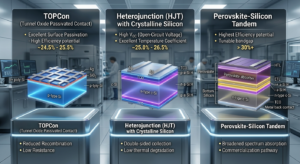
- TOPCon vs HJT vs tandem — the three architectures competing right now
- Transparent panels — windows that generate, and the efficiency trade
- Coatings — anti-reflective and self-cleaning surfaces
- How panels are made — sand to finished module
- Panel components — what is inside the laminate
- Latest panel technology — what is actually shipping this year
- 2026 innovations — the developments worth watching
- The future of panels — longer-range predictions, clearly labelled as such
Mounting and racking
Attachment is where most installations fail, not the panels. These cover the structure under the array.
- Mounting systems — the main racking families compared
- Heavy-duty mounting — for high wind and extreme conditions
- Ground mount solar — foundations, permits, trenching and when it beats a roof
- Tracking systems — single and dual axis, and when they pay
- Panel weight and loading — what your roof structure has to carry
- Tilt and azimuth — what each degree off optimum actually costs
- Floating solar — arrays on water, and why they run cooler
- Building-integrated PV — solar that replaces a building material
- Solar shingles cost — the one situation where they make financial sense
Wiring and balance of system
The unglamorous parts that decide whether a system passes inspection and survives twenty years outdoors.
- MC4 connectors — the industry standard, and why mismatched brands fail
- Connector types — what to use where, and what not to mix
- Cable management — the difference between a tidy array and a service call
- Grounding and bonding — what actually fails inspection
- MPPT vs PWM controllers — how much energy the cheaper option throws away
- Essential installation parts — the checklist before you start
- Hardware for arrays — racking and fixings for larger installations
- Top rated hardware — brands and certifications worth paying for
- Installation tools — what the job actually requires
Planning and siting
- How many panels do I need? — a working calculator plus the maths behind it
- Tree shading — why one shaded panel can drag down a whole string
- Securing your panels — theft and tamper protection
- Recycling technology — what happens at end of life
- Outdoor solar lights — the small-scale end of the same technology
- Storage and grid outlook — where the wider system is heading
FAQ
Which solar panel brand is best?
There is no single winner. Compare product warranty, temperature coefficient, degradation rate and how likely the maker is to still exist in fifteen years.
Does panel efficiency matter?
Mainly when roof space is limited. Otherwise cost per watt matters more than efficiency per square metre.
How long do solar panels last?
Most are warranted for 25 years of output and keep producing beyond that at a gradually reduced level.
What is the most common hardware failure?
Connectors and mounting hardware, not the panels themselves. Mismatched connector brands and poor flashing cause most service calls.
Do I need a tracker?
Rarely at residential scale. The extra output seldom covers the hardware and maintenance.
Can I mix panel models in one array?
Not within a series string. With microinverters or optimizers it is tolerable but still not ideal.
More
Browse the full Solar Components & Hardware category, or see the inverter topic guide.
Module performance data is published by the National Renewable Energy Laboratory and the U.S. Department of Energy.
Related Posts

Leave a Comment
Your comment will be published after it has been approved. Please send comments that do not contain slang words.